There are moments in a year when the calendar suddenly stops looking like a calendar and starts looking like a mirror. There are 16 weeks left in 2026, and somehow that number feels both generous and slightly rude.
We have already spent most of the year, yet the remaining weeks are still enough to finish something important, change a habit, close a project, or finally begin the thing that kept getting pushed to “next month.”
At this point, 2026 is 69% complete, with roughly 16 weeks remaining, or about 113 days remaining according to the countdown figures being tracked here. That means the year is not over, not even close really, but the comfortable illusion that there is “plenty of time” is beginning to disappear.
The useful question isn’t only how many weeks are left in 2026? The better question is what can be done with those weeks. Time remaining becomes much more interesting when it is turned into goals, deadlines, milestones, weekly action, and a little bit of honest urgency.
| 2026 Time Remaining | Amount |
|---|---|
| Weeks left | 16 weeks |
| Weeks passed | 35 weeks |
| Days left | 113 days |
| Working weeks left | 11 weeks |
| Year completed | 69% |
How Many Weeks Are Left in 2026?
The headline number is simple: 16 weeks left in 2026. The accompanying countdown gives 35 weeks passed, 113 days remaining, and approximately 11 working weeks left after accounting for the realities of the working calendar.
There is a small wrinkle with calendar arithmetic, because a year doesn’t always behave like a neat box containing exactly 52 identical weeks. The supplied calendar count uses 53 weeks for 2026, so the exact answer can depend on whether you mean complete weeks, calendar week numbers, or the nearest whole-week countdown.
For everyday time management, however, 16 weeks is a wonderfully practical number. It is long enough to make meaningful progress and short enough to force decisions. Sixteen weeks can become sixteen weekly milestones, four monthly checkpoints, or even a very serious final sprint toward December 31, 2026.
So if you’ve been asking, how many weeks remain in 2026, the practical answer is: 16 weeks based on this countdown. Don’t spend three of them deciding what you want to accomplish, though. That’s the sneaky little trap.
16 Weeks Left in 2026: What Does That Really Mean?
Having 16 weeks left in 2026 means there is still a substantial block of remaining time, but it needs to be viewed differently from the beginning of the year.
January encourages ambitious annual goals because twelve months feel enormous. September has a different personality. It looks at the same goal and quietly asks, “Right, but what are you actually doing this week?”
That change in time perception can be useful. Instead of thinking about an entire year, divide the remaining period into smaller pieces. Four months sounds manageable. Sixteen weeks sounds actionable. One week sounds almost impossible to hide inside.
This is where weekly planning becomes more valuable than vague annual motivation. A yearly goal such as “improve my fitness” is pleasant but blurry. A weekly target such as “complete three training sessions this week” gives the brain something concrete to chase.
The same principle works for savings goals, reading goals, learning goals, business targets, and unfinished personal projects. The calendar isn’t asking you to become a different person by December. It is asking what you can consistently do between today and year-end.
16 Weeks Left in 2026: Turn the Countdown Into a Plan
The easiest way to use 16 weeks left in 2026 is to stop treating the countdown as a fact and start treating it as a planning tool.
Begin with three questions: What absolutely needs to be finished? What would be wonderful to finish? And what can safely wait until 2027? That third question matters more than people admit, because prioritization is often more productive than adding another heroic task to an already crowded list.
Once the priorities are clear, work backward from the deadline. This is known as backward planning or reverse-engineering goals. If a project must be completed by year-end, identify the final deliverable, then the milestones immediately before it, and then the weekly actions required to reach those milestones.
Sixteen weeks can therefore become a small project structure rather than one frightening countdown. Week by week, the big objective becomes less dramatic and more ordinary, which is exactly what you want.
2026 Progress: 69% Complete
The reported 2026 progress is 69%, which gives a useful psychological snapshot of the year.
A percentage can feel oddly emotional. Seeing 69% complete may create urgency because most of the year has already disappeared, but it can also be encouraging. You still have roughly one-third of the year available in the form of the remaining weeks and days.
This is where time awareness becomes powerful. When people think only in terms of months, September can feel like “there’s still autumn and winter.” When they see 113 days remaining, the same period suddenly becomes a finite resource.
Neither perspective is wrong. They simply produce different behavior.
If the countdown makes you panic, shrink the goal. If it makes you feel motivated, turn that energy into an actionable goal. The purpose of tracking time isn’t to make every morning feel like an emergency; it’s to make sure important things don’t quietly become forgotten things.
2026 Weeks Remaining by Month
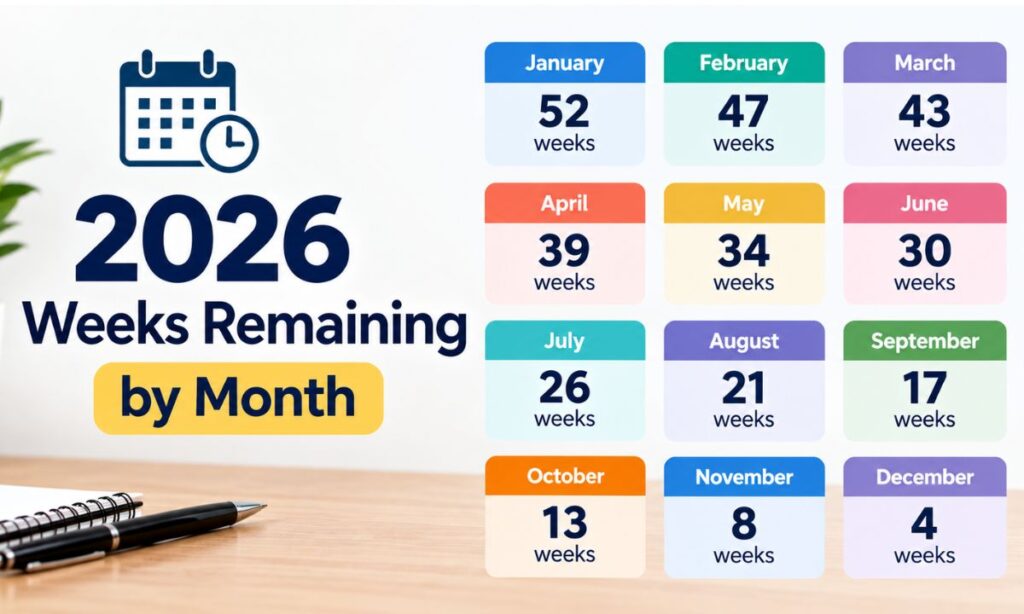
A month-by-month countdown gives another useful way to understand the progression of the year. Earlier in 2026, the estimated remaining weeks looked much larger, while the number steadily contracted as each month passed.
The supplied progression is:
- January — 52 weeks
- February — 47 weeks
- March — 43 weeks
- April — 39 weeks
- May — 34 weeks
- June — 30 weeks
- July — 26 weeks
- August — 21 weeks
- September — 17 weeks
- October — 13 weeks
- November — 8 weeks
- December — 4 weeks
These figures are best understood as a year countdown entity set, rather than twelve perfectly interchangeable mathematical measurements. Calendar week conventions and rounding can make displayed numbers differ by a week.
Still, the pattern tells the story beautifully. September feels like the doorway, October becomes the narrowing corridor, November gets serious, and December is basically the calendar tapping its foot.
What Can You Accomplish in 16 Weeks?
Quite a lot, actually, if the goal is realistic. A beginner fitness program often fits comfortably into an 8–12 week period, meaning 16 weeks can provide enough room for a complete training cycle plus time for adjustment or recovery.
Learning works similarly. An 8–12 week course can occupy a large part of the remaining year without consuming every waking hour. By dividing the material into weekly milestones, a person can make visible progress without waiting for some mythical “perfect study period.”
Reading is another easy example. At a pace of one book every two weeks, sixteen weeks could theoretically provide room for around eight books. That number is not a command from the reading police, thankfully, but it demonstrates how a small recurring habit compounds.
Savings can also be translated into weekly mathematics. If your weekly savings target is fixed, multiply it by the number of weeks remaining and you immediately have a rough year-end contribution. Suddenly “save more money” becomes a measurable financial target.
The important word is measurable. A goal becomes easier to manage when you can tell whether it happened or didn’t.
Using the Remaining Weeks for Work and Business
For entrepreneurs, project managers, employees, and business owners, the remaining period of 2026 may carry extra significance because Q4 often brings deadlines that cannot simply wander into next year.
Q4 planning can include sales targets, project milestones, budgets, reporting, hiring decisions, customer commitments, and fiscal year-end reporting. Each one benefits from being converted into smaller weekly actions.
A project manager might divide sixteen weeks into discovery, production, testing, revision, and delivery phases. A sales team might break a year-end target into monthly numbers and then into weekly targets. An entrepreneur might identify the three high-priority projects that genuinely deserve attention rather than attempting to finish everything at once.
Working time is also not the same as calendar time. Federal holidays, vacation, weekends, and ordinary interruptions reduce the number of useful workdays. The supplied estimate puts 11 working weeks left, which is why “16 weeks” should not automatically be interpreted as sixteen full-time working blocks.
A calendar can contain 16 weeks while your actual productive schedule contains considerably less. That’s not bad news; it’s just more honest planning.
How to Calculate Weeks Remaining in 2026
If you want to calculate weeks left in 2026 yourself, the basic idea is wonderfully unglamorous.
Take the number of days remaining in 2026 and divide it by seven:
Days remaining ÷ 7 = weeks remaining
If the result contains a decimal, you can round it according to what you need. Someone planning a project may care about partial weeks, while someone making a simple countdown may prefer the nearest whole week or complete weeks only.
For example, 113 days divided by seven equals approximately 16.14 weeks. That supports the practical display of about 16 weeks remaining.
The exact number can change every day, naturally. Tomorrow’s countdown should not be expected to have the same number of days as today’s. The calendar is annoyingly committed to moving forward.
How to Calculate Working Weeks Remaining
Working weeks require another layer because weekends and holidays don’t normally count as standard workdays.
A simple approximation is:
Remaining Monday–Friday workdays ÷ 5 = working weeks
But this is only an estimate until holidays and vacation are removed. If a period contains 55 available weekdays, for example, the basic calculation gives 11 working weeks.
For more serious deadline planning, count actual business days between the start date and December 31, 2026, then remove planned vacation and relevant holidays. This produces a more realistic schedule than simply taking 16 calendar weeks and assuming every day is available.
That distinction matters for anyone handling work projects, business planning, project deadlines, or year-end reporting.
Calculate the Countdown in Excel
You can also create a simple Excel weeks remaining formula so the countdown updates automatically.
A practical date-based approach is to calculate the difference between today’s date and the end of the year, then divide by seven. Microsoft Excel’s TODAY() function is useful because it automatically returns the current date.
A conceptual formula is:
=(DATE(2026,12,31)-TODAY())/7
That gives the approximate number of weeks remaining, including a fractional week. If you want a whole-number display, functions such as ROUND() or INT() can be used depending on whether you want rounding or complete weeks only.
You can also combine DATE(), YEAR(), TODAY(), and other spreadsheet functions to make a dynamic date formula that automatically works for the current year.
The nice part is that once the spreadsheet is built, you don’t have to manually change the countdown each morning. The formula does the mildly boring work while you get on with your actual goals.
How to Calculate Weeks Left in Google Sheets
The same basic concept works in Google Sheets.
A formula such as:
=(DATE(2026,12,31)-TODAY())/7
can provide the approximate number of weeks between today and the final day of 2026.
For a reusable spreadsheet, you can replace the fixed year with a formula based on YEAR(TODAY()), creating an automatically updating formula that rolls forward as the calendar changes.
This can be useful for goal tracking, deadline tracking, annual planning, and personal dashboards. A simple spreadsheet with columns for goal, deadline, weekly milestone, status, and remaining weeks can turn an abstract year countdown into something you can actually operate.
Why Does the Year Feel So Fast?
There is a psychological reason the later part of a year can feel strangely compressed. Time perception is influenced by routines, attention, novelty, and memory.
When weeks become highly repetitive, fewer moments may stand out as distinct memories. Monday becomes Tuesday, Tuesday becomes Thursday, and suddenly you’re wondering who gave December permission to arrive.
This doesn’t mean the brain literally changes the clock. Rather, familiar routines can create fewer memorable markers, which can make a long period feel shorter when remembered afterward. That’s one reason deliberately tracking weekly milestones can make the passage of time feel more visible.
A weekly review, a short journal entry, a progress chart, or even a simple list of completed tasks gives the brain evidence that something happened. The weeks stop blurring quite so completely.
So the countdown isn’t merely a productivity trick. It can also be a form of temporal awareness.
Make the Final 16 Weeks Feel Distinct

If you want the remaining year to feel meaningful, give each week a job.
That doesn’t mean squeezing a life-changing achievement into every seven-day period. A week might be for completing a report, finishing a chapter, attending three workouts, saving a specific amount, completing a course module, or simply clearing one stubborn task from the list.
You can create sixteen small checkpoints, each connected to a broader annual goal. At the end of every week, ask what moved forward, what stalled, and what needs to change next week.
This creates a feedback loop: weekly action → progress tracking → adjustment → another weekly action.
It is less glamorous than a giant motivational promise, but consistency usually beats drama. A goal doesn’t care how inspirational you felt on September 9; it cares whether you did the work.
A Simple 16-Week Goal Strategy
Start by choosing no more than three major year-end goals. Too many priorities quickly become a disguised lack of prioritization.
Next, break each goal into four monthly milestones. Then divide those milestones into weekly tasks. This is classic goal breakdown, but it works because it reduces the distance between intention and action.
For example, a learning goal might become four modules, with each module divided into several weekly study sessions. A fitness goal could become four progressive blocks. A savings goal could become sixteen weekly deposits.
Keep the targets realistic enough that an ordinary bad week doesn’t destroy the entire plan. Life will produce interruptions, because life is apparently very committed to project management sabotage.
Most importantly, review your plan every week rather than creating it once and abandoning it in a spreadsheet somewhere.
What Not to Do With the Remaining Time
The biggest mistake with 16 weeks remaining is trying to rescue every unfinished ambition from the entire year.
Not every January goal deserves a dramatic comeback. Some goals were useful when you made them and irrelevant now. Others may still matter enormously. Separate the two.
Another mistake is confusing activity with progress. Filling every day with tasks doesn’t guarantee that the important work is moving. High-priority projects need protected attention, not merely more checkboxes.
Finally, don’t wait for Monday, next month, or the “right time.” The remaining year is made of ordinary days. Year-end goals are usually reached through remarkably uncinematic actions repeated when nobody is applauding.
The Remaining Time Is Still Yours
Sixteen weeks can look small when compared with an entire year, but it looks surprisingly large when converted into actions.
There are approximately 113 days remaining, around 16 weeks, and a more limited number of working weeks left in 2026. Those numbers are not meant to pressure you into turning the rest of the year into a productivity contest. They are simply a clearer measurement of the time available.
Use the countdown to decide what matters. Use weekly planning to make it manageable. Use milestones to see progress. Use backward planning when a deadline matters. And use the calendar as information, not as a source of guilt.
The year doesn’t need a spectacular ending to have a meaningful one. A finished project, a healthier routine, money saved, books read, skills learned, or promises finally kept can all count.
Read more :
FAQ’s
how many weeks left in 2026
There are 16 weeks left in 2026, giving you around 113 days to complete your goals, meet deadlines, and make the most of the year.
how many weeks left in 2025
There are 0 weeks left in 2025, because 2025 has already ended and the calendar has moved into 2026.
weeks left in 2026
There are approximately 16 weeks left in 2026, making this a useful time to focus on year-end goals, weekly milestones, and unfinished plans.
weeks left in 2025
There are no weeks left in 2025, as the year ended on December 31, 2025.
how many weeks are left this year
In 2026, there are currently about 16 weeks left this year, so you still have enough time to make meaningful progress before year-end.
Conclusion
There are 16 weeks left in 2026, and that is neither a reason to panic nor an excuse to postpone everything until 2027. It is simply a useful moment to look at the clock with clear eyes.
The first 35 weeks are already part of the story. They can’t be edited, enlarged, or politely asked to return. But the remaining weeks are still unwritten in the most practical sense.
Take the time remaining, choose a handful of meaningful goals, turn them into weekly milestones, and give the next week something specific to accomplish. Then do the same thing again.
By the time December 31, 2026 arrives, you may not have completed everything you imagined in January. Almost nobody does. But you can still look back and know that the final sixteen weeks weren’t just days disappearing from a screen.
They were time you actually used.