There is something oddly satisfying about putting a future date on the calendar and watching the distance between today and that little square slowly disappear. Maybe June 20th is a birthday, a holiday, a wedding date, a trip, a work deadline, or simply a day you have been waiting for. Whatever the reason, knowing exactly how many weeks until June 20th can make a faraway date feel a bit more manageable.
If you are counting from today, September 17, 2026, the next June 20th falls on June 20, 2027. That gives us 276 days, which equals 39 full weeks and 3 remaining days.
So, in simple terms, there are 39 weeks and 3 days until June 20th from September 17, 2026. If you prefer a decimal answer, that is approximately 39.43 weeks. Tiny bit more than 39 weeks, but not quite 40.
The interesting thing about a countdown is that the number itself is only half the story. A week can represent seven ordinary days, or it can represent a deadline getting closer, another stage of a project, a training milestone, or a long-awaited family celebration.
How Many Weeks Until June 20th From Today?
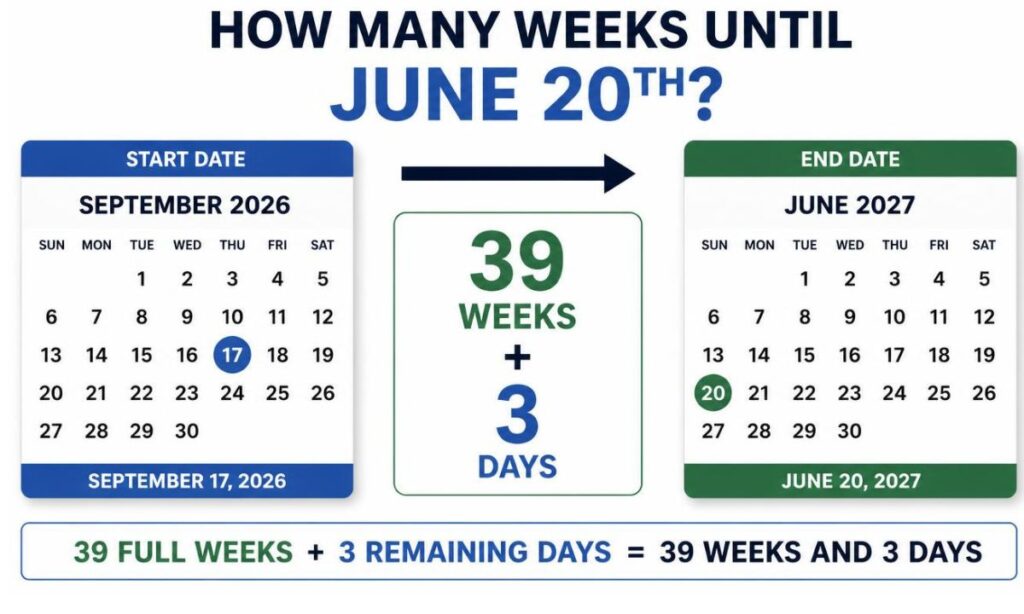
When people search for how many weeks until June 20th from today, they usually want a straightforward countdown rather than a complicated lesson in calendars. The calculation depends completely on the current date, because “today” keeps moving.
Using September 17, 2026 as the start date and June 20, 2027 as the end date, the date difference is 276 days.
Since one week = 7 days, we divide 276 by 7:
276 ÷ 7 = 39 weeks with 3 days remaining
Therefore:
39 full weeks + 3 remaining days = 39 weeks and 3 days
That is the answer to how many weeks till June 20th from September 17, 2026.
If you check the same question a month later, the answer will naturally be smaller. That’s why a countdown is best understood as a moving measurement rather than a permanent number carved in stone.
How Many Weeks Until June 20th in Days?
Sometimes weeks are a little too neat for what you actually need. A project manager might care about weeks, while someone planning travel may want the total number of days.
From September 17, 2026, to June 20, 2027, there are 276 days.
Because every week contains seven days, the week calculation is:
276 ÷ 7 = 39 remainder 3
So you have:
- 276 total days
- 39 full weeks
- 3 remaining days
- Approximately 39.43 weeks
- 39 weeks and 3 days
This is also a useful example of why simply saying “about 39 weeks” can sometimes hide useful information. Those extra three days may matter when you are working around a payment deadline, flight, examination, appointment, or event.
A days until June 20 calculation can therefore be more precise for short-term planning, while weeks and days are often easier for people to understand at a glance.
How a Weeks Between Dates Calculator Finds the Answer
A weeks between dates calculator does not need mysterious calendar magic. At its heart, it compares two calendar dates, finds the days between dates, and then converts those days into weeks.
The basic process is surprisingly simple.
First, select a start date. Then select an end date. A typical weeks calculator or date calculator subtracts the earlier date from the later one and obtains the total number of days.
After that, the calculation uses seven days per week.
The basic formula is:
Weeks = Total Days ÷ 7
If you want only full weeks, you round the result down.
For the June 20th example:
276 ÷ 7 = 39.428571…
Rounded down, that gives 39 full weeks.
The leftover portion represents three additional days.
A good online calculator can perform this automated calculation almost instantly, which is handy when dates cross several months and you don’t particularly fancy counting tiny squares on a calendar at midnight.
What Does the Date Range Include?
The date range matters because changing either endpoint changes the result. A start date of September 17, 2026 and an end date of June 20, 2027 produces one result, while September 18 and June 20 produces another.
This sounds obvious, but date calculations can become confusing when people accidentally count the starting day as a complete elapsed day.
For ordinary elapsed-time calculations, the difference between the two dates is what matters. In this example, September 17 to June 20 is 276 days.
The months along the way are:
- September
- October
- November
- December
- January
- February
- March
- April
- May
- June
Notice that the calculation crosses from one calendar year into another. September 2026 belongs to one year, while June 20 belongs to 2027.
That year change does not make the calculation difficult for a proper date difference calculator, but it is one reason manual counting can become annoying.
How to Calculate Weeks Between Dates Manually
If you do not have an online date calculator, you can still work everything out by hand. The trick is to avoid trying to count every week directly.
Start by calculating the total number of days in the date range.
For September 17, 2026 through June 20, 2027, the elapsed period is 276 days. Then apply the standard weeks formula:
Full weeks = Total Days ÷ 7, rounded down
So:
276 ÷ 7 = 39 full weeks
Now calculate the remaining days formula:
Remaining Days = Total Days − (Full Weeks × 7)
That becomes:
276 − (39 × 7) = 3 days
The final answer is therefore:
39 weeks and 3 days
This approach is useful because it separates the calculation into two clean pieces: complete weeks and leftover days. You don’t have to stare at January, February, March, April and May wondering whether your counting has gone slightly sideways.
Why February Can Affect Date Calculations
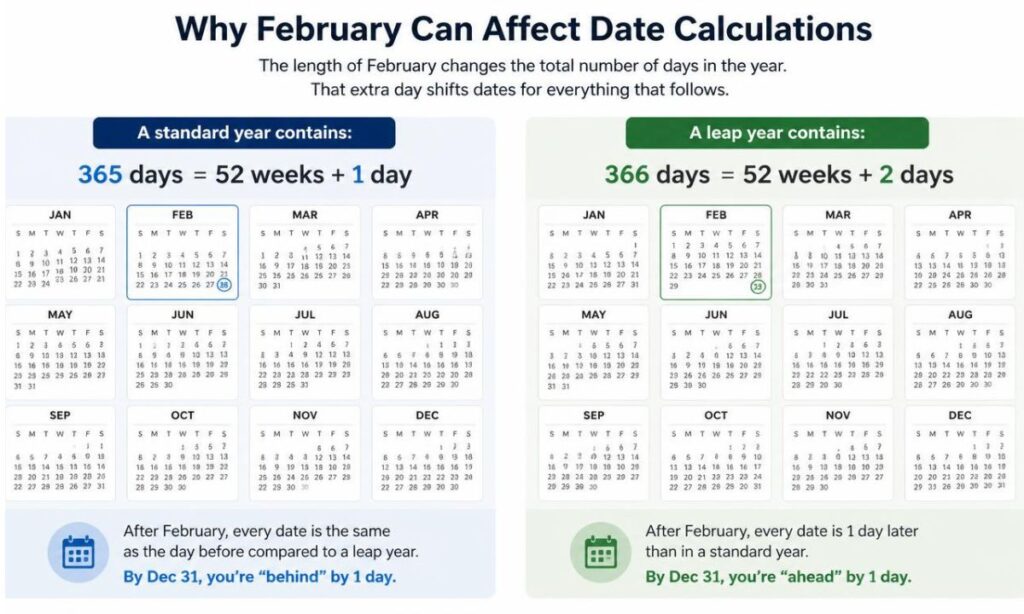
February is the troublemaker of the calendar, although it is hardly doing anything wrong.
Most years have 365 days, while a leap year has 366 days because February contains February 29. That extra day can affect calculations involving dates that cross February.
A standard year contains:
365 days = 52 weeks + 1 day
A leap year contains:
366 days = 52 weeks + 2 days
The June 20, 2027 countdown crosses February 2027. Fortunately, 2027 is not a leap year, so February has 28 days.
This is an important detail when performing a manual date calculation. If your date range crosses a leap year, forgetting February 29 can make the final result one day wrong.
Online tools generally handle this automatically. A reliable date duration calculator can account for the correct number of days in every month without requiring you to remember which February was feeling generous.
Using a Date Picker to Calculate June 20th
Many online calculators make the process almost laughably easy.
You usually see two fields labeled Start date and End date. Click the first field, choose your starting day using a date picker, and then select June 20th as the ending date.
After pressing Calculate Weeks, the tool can display the result.
A useful weeks between dates calculator may show:
- Total weeks
- Full weeks
- Remaining days
- Total days
- Date difference
- The selected date range
This is particularly helpful when you are working with future dates or checking past dates. The same basic calculation works in both directions; only the interpretation of the result changes.
If the date is June 20, 2027 and you are counting backward to September 17, 2026, you’re measuring the same time period in reverse.
Why Knowing the Weeks Until June 20th Can Help With Planning
A June 20th countdown can be useful for far more than satisfying curiosity.
Suppose June 20th is a project deadline. Knowing that you have 39 weeks and 3 days gives you a rough framework for creating weekly milestones. Instead of thinking, “The deadline is ages away,” you can divide the work into smaller pieces.
For project management, weeks can become useful planning units.
The same idea works for:
- Project scheduling
- Work deadlines
- Agile development
- Agile sprints
- School planning
- Academic planning
- Study schedules
- Lesson plans
- Event planning
- Wedding planning
- Trip planning
- Fitness goals
- Financial planning
- Payroll planning
- Product launches
A person preparing for a 12-week training plan, for example, may use June 20th as the final target and work backward from that date. Someone organizing a wedding might use the countdown for invitations, venue arrangements and other weekly milestones.
The date itself doesn’t change, but breaking the time between dates into manageable pieces can make planning feel much less enormous.
June 20th as a Countdown Date
There is a particular charm to the phrase “countdown to June 20.” It turns a plain calendar date into something with a little emotional weight.
For one person, June 20th might be a birthday. For another, it could be the day a long-awaited trip begins. Someone else might be watching the date because it marks a payment deadline, a product launch, or the end of an academic period.
That is why searches such as weeks until June 20, weeks till June 20, and how many days until June 20 are really asking the same underlying question:
“How much time do I have left?”
The answer is measurable, but what that measurement means depends on the person looking at the calendar.
Thirty-nine weeks can feel incredibly long when you are waiting for something exciting. Yet when those weeks are divided into ordinary Mondays, busy Wednesdays and lazy Sundays, the time tends to move much faster than expected.
Using Excel or Google Sheets for Weeks Between Dates
If you frequently calculate dates, a spreadsheet can become your own little online weeks calculator, minus the fancy buttons.
In Excel, if cell A2 contains the start date and B2 contains the end date, you can use:
=INT((B2-A2)/7)
This returns the number of full weeks between the two dates.
To find the leftover days, you can use:
=MOD((B2-A2),7)
The first formula gives complete weeks, while the second gives the remaining days.
Together, they can produce a result such as:
39 weeks and 3 days
The same approach can be used in Google Sheets. It is particularly handy for people managing spreadsheets for project timelines, school schedules, payment deadlines, employee planning or recurring events.
You don’t need a huge spreadsheet system. Sometimes two dates and two formulas are enough to stop the calendar from becoming your enemy.
Weeks and Days: Which Answer Is Better?
There isn’t one universally useful way to express a date difference.
If you’re planning something months away, weeks and days may be the easiest format to understand. Saying “39 weeks and 3 days” gives you both the larger time period and the precise leftover amount.
If you’re dealing with a short deadline, the total number of days may be more practical.
For example:
276 days is precise.
39 weeks and 3 days is easier to visualize.
39.43 weeks is mathematically accurate, but probably less friendly in everyday conversation.
This is why a good weeks calculator online often provides several versions of the result instead of forcing you to choose one.
How to Make Your June 20th Countdown More Useful
A countdown becomes much more useful when you connect it to something concrete.
Instead of writing “39 weeks until June 20th” and forgetting about it, turn those weeks into small checkpoints.
For a work project, you could assign a milestone every few weeks. For a trip, you could use the countdown for booking, packing and itinerary planning. For a fitness goal, you might divide the period into training blocks.
Even a simple note on your phone can help.
Try writing:
June 20th — 276 days away
Then underneath it, add the reason the date matters. Suddenly, the number has a purpose.
You can also use a calendar date calculator, spreadsheet, reminder app, or countdown calculator to keep the date visible.
The goal isn’t to obsess over every passing day. It’s simply to turn a distant date into something you can actually plan around.
A Simple Way to Remember the Calculation
If you forget everything else, remember one tiny rule:
1 week = 7 days.
Then:
Weeks = Total Days ÷ 7
For complete weeks:
Full weeks = Total Days ÷ 7, rounded down
And for the leftover:
Remaining days = Total Days − (Full Weeks × 7)
That’s basically the whole engine behind a simple week calculation.
For June 20th from September 17, 2026:
276 ÷ 7 = 39 weeks and 3 days
No complicated mathematics hiding behind the curtain. Just dates, subtraction and a little division.
Read more : How Many Weeks Till May 28?
Frequently Asked Questions
How many weeks are there until June 20th?
From September 17, 2026, until June 20, 2027, there are 39 weeks and 3 days, or 276 days.
How many days until June 20th?
Using September 17, 2026 as today, the next June 20th is 276 days away.
How do I calculate the number of weeks between dates?
Find the total number of days between the two dates and divide that number by 7. Round down if you want full weeks, then calculate the leftover days.
How many full weeks are between two dates?
Divide the total days by 7 and round down. For 276 days, that produces 39 full weeks.
Can I calculate weeks between past and future dates?
Yes. A weeks between dates calculator can generally compare both past dates and future dates. You simply enter the appropriate start and end dates.
Does a leap year change the calculation?
Yes. A leap year has 366 days, including February 29, so a date range crossing that extra day can have a different result than the same range during a normal year.
Is June 20th always on the same weekday?
No. The weekday changes from year to year. June 20th in one calendar year can fall on a completely different weekday in another year.
Conclusion
If today is September 17, 2026, the next June 20th is June 20, 2027.
The exact countdown is:
276 days
or
39 full weeks and 3 remaining days
So the answer to how many weeks until June 20th is 39 weeks and 3 days.
That number will, of course, change as the days pass. Tomorrow there will be slightly less time. Next month, less again. Eventually, the countdown that once looked enormous will suddenly be sitting right there on the calendar.
Whether June 20th represents a birthday, deadline, trip, celebration, personal goal, or simply a date you don’t want to forget, measuring the time in weeks and days gives you a clear view of the journey ahead.
Sometimes a distant date feels easier when you stop looking at the entire calendar and just take it one week at a time. June 20th may be 276 days away today, but every week that passes quietly carries you closer to it.