Sometimes a date sitting quietly on the calendar can feel surprisingly far away. May 13 might be a deadline, a holiday, a trip date, a birthday, a school milestone, or simply a day you are waiting for with a little more excitement than usual. Whatever the reason, knowing how many weeks until May 13 makes that waiting period much easier to understand.
If you are counting from today, September 18, 2026, the next May 13 falls on May 13, 2027. That gives you 33 weeks and 6 days until May 13, or 237 total days. It is almost 34 complete weeks, which makes the countdown feel a bit more manageable when you see it in weekly terms.
A weeks calculator can make this kind of date calculation almost effortless. Instead of staring at a calendar and counting every square, you can enter your start date and end date, then let the calculator work out the exact number of weeks and remaining days for you.
How Many Weeks Until May 13?
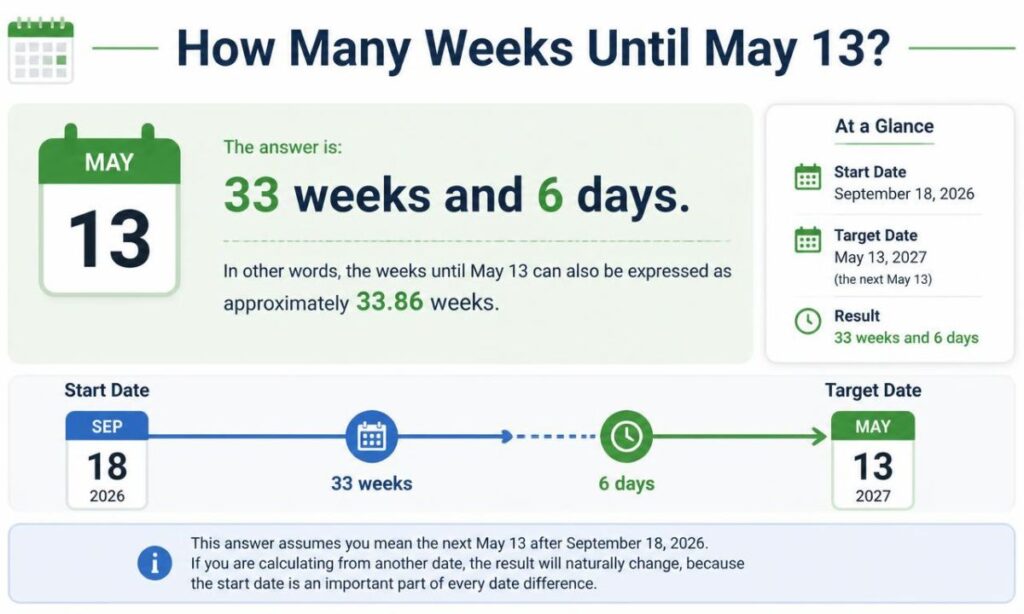
From September 18, 2026, to May 13, 2027, there are 237 days in total. Since there are 7 days in a week, dividing 237 by 7 gives 33 complete weeks with 6 days left over.
So the answer is:
How many weeks until May 13? 33 weeks and 6 days.
In other words, the weeks until May 13 can also be expressed as approximately 33.86 weeks. The decimal version is useful for certain calculations, but for ordinary planning, 33 weeks and 6 days is much easier to read.
This answer assumes you mean the next May 13 after September 18, 2026. If you are calculating from another date, the result will naturally change, because the start date is an important part of every date difference.
How Many Days Until May 13?
If you are wondering how many days until May 13, the answer from September 18, 2026, is 237 days.
That number gives another useful way to look at the same countdown. A person planning a project might think in weeks, while someone waiting for an event may prefer days. Both measurements describe exactly the same date range, just from slightly different angles.
There are 237 days between the two dates, which can be converted into:
- 33 full weeks
- 6 remaining days
- 237 total days
- Approximately 33.86 weeks
The difference between full weeks and decimal weeks is worth noticing. A result of 33.86 weeks does not mean 34 full weeks have passed. The calendar contains 33 complete groups of seven days, plus six additional days.
Weeks Until May 13: A Simple Countdown
A May 13 countdown becomes easier when you break a large date range into smaller pieces. Instead of thinking about hundreds of days at once, you can think about months, weeks, or even weekly milestones.
For example, 33 weeks is enough time to divide a long project into several stages. You could create a first milestone after four weeks, another after eight weeks, and continue from there. Suddenly, a distant date stops being one enormous block of time.
This is one reason people often prefer a weeks and days calculator instead of only a day counter. Weeks fit naturally into calendars, schedules, work plans, school timetables, and personal goals.
And yes, six leftover days can matter too. Those little extra days are easy to forget when doing a quick calculation in your head, which is exactly where a calculator can save some confusion.
How a Weeks Between Dates Calculator Works
A weeks between dates calculator is basically a shortcut for a calculation that can also be done manually. You provide two dates, and the tool determines the total number of days between dates before converting those days into weeks.
Usually, the process is very simple.
- Select your start date.
- Select May 13 as the end date.
- Click Calculate Weeks.
- The calculator finds the date difference.
- It displays the full weeks and remaining days.
The useful thing about an online date calculator is that you don’t have to manually remember how many days each month contains. The calculator handles months of different lengths and can also account for leap years when they occur within the selected period.
So if your brain is already busy with everything else on your schedule, there is really no need to make it count calendar squares too.
How to Calculate Weeks Between Two Dates Manually
You can also calculate weeks between two dates without a calculator. The basic idea is straightforward: first find the number of days between the two dates, then divide that number by seven.
The basic formula is:
Weeks = Total Days ÷ 7
For the May 13 countdown:
237 ÷ 7 = 33 weeks with 6 days remaining
The whole-number portion represents the full weeks. The remainder represents the remaining days.
Another useful formula is:
Remaining Days = Total Days – (Weeks × 7)
Using the same example:
237 – (33 × 7) = 6 remaining days
This is a simple manual week calculation, but it can become annoying when the dates are far apart. You have to account for every month between the dates, and that’s where small mistakes can sneak in rather easily.
Why the Start Date Matters
When someone asks how many weeks until May 13, the answer cannot be completely separated from the starting date. May 13 is the destination, but the starting point determines the distance.
For example, May 13 is always May 13, but the number of weeks until it will be different in January, February, March, April, or September. A countdown is therefore really a comparison between two points on a calendar.
The start date tells the calculator where the countdown begins, while the end date tells it where the countdown finishes. Once those two dates are entered, the date interval calculator can determine the duration.
This is also why phrases such as “from today” need to be interpreted carefully. Today changes every 24 hours, so an answer that is correct today will eventually become outdated tomorrow.
May 13 and the Calendar
May is the fifth month of the year, and May 13 always occurs 13 days into the month. The year attached to that date matters, though, particularly when you are calculating across several months.
A calendar-based calculation may involve January, February, March, April, and May before reaching the target. February deserves particular attention because its length changes during a leap year.
A normal year contains 365 days, while a leap year contains 366 days because February has February 29. That extra day can affect calculations when your date range crosses a leap-year February.
For the September 18, 2026 to May 13, 2027 calculation, February 2027 has 28 days, so there is no leap-day adjustment needed.
What Does 33 Weeks and 6 Days Mean?

The phrase 33 weeks and 6 days simply means the date is 33 complete seven-day periods away, with six additional days remaining.
Since seven days make one week, 33 weeks account for:
33 × 7 = 231 days
Then:
231 + 6 = 237 days
This is why both answers are consistent. You are not looking at two different countdowns. You are simply expressing the same duration in two different formats.
The weekly format can be especially helpful when organizing tasks. For example, if you have a 12-week goal, you can immediately see how many such blocks fit into the period before May 13.
Planning With the Weeks Until May 13
Knowing the weeks until May 13 can be useful for more than curiosity. A date becomes much easier to manage when you turn it into smaller milestones.
For project management, 33 weeks can provide a long planning window. A team could divide a large project into weekly milestones, review progress at regular intervals, and reserve the final weeks for testing or finishing touches.
For school planning, a student could use weekly intervals to organize study schedules, assignments, revision sessions, or academic planning. Instead of saying, “May 13 is months away,” a more practical approach might be, “I have 33 full weeks and six days.”
For event planning, the same principle applies. A wedding, birthday, trip, or product launch can be broken into weekly tasks. The calendar suddenly becomes less like a wall of dates and more like a roadmap.
Using a Weeks Calculator for Future Dates
An online free weeks calculator is useful when you need to calculate a future date without doing the arithmetic yourself. You simply choose the relevant dates and let the tool determine the interval.
A good weeks between dates calculator can show more than just a single number. Depending on the tool, it may provide total days, full weeks, and remaining days, giving you a clearer picture of the entire duration.
This can be particularly helpful when calculating several different deadlines. You might compare May 13 with another date and quickly see which deadline has the longer preparation period.
It also works in reverse. The same type of calculator can be used to calculate past dates, not only future dates. You can enter an earlier date as the start and a later date as the end, or reverse the two depending on how the calculator handles date direction.
How to Calculate Weeks in Excel
If you regularly work with dates, you may want to calculate weeks in Excel rather than use an online tool each time.
Suppose your start date is in cell A2 and your end date is in cell B2. You can first calculate the number of days between the dates by subtracting the two cells.
A basic formula is:
=B2-A2
To calculate complete weeks, you can use:
=INT((B2-A2)/7)
The INT function rounds the result down to the nearest whole number, giving you the number of complete weeks.
To find leftover days, a formula using MOD can be useful:
=MOD(B2-A2,7)
That gives the remainder after dividing the total number of days by seven.
This can be handy for project schedules, spreadsheets, deadlines, and long-term planning where several date ranges need to be calculated at once.
How to Calculate Weeks in Google Sheets
The same general approach works when you want to calculate weeks in Google Sheets.
If A2 contains the starting date and B2 contains the target date, you can use:
=INT((B2-A2)/7)
for complete weeks.
For remaining days:
=MOD(B2-A2,7)
This approach gives you the same basic information as an online date difference calculator, although spreadsheets become more useful when you have many dates to process.
For a single May 13 countdown, an online calculator is usually quicker. For a list of project deadlines or weekly milestones, a spreadsheet may save more time.
Weeks, Days, and International Date Standards

Dates can sometimes become confusing when people in different countries use different date formats. The international standard ISO 8601 helps reduce this ambiguity by using a year-month-day structure for dates.
There is also an ISO week standard for identifying calendar weeks. ISO week numbering generally considers Monday the first day of the week, with Week 01 determined using the standard’s first-Thursday rule.
That is slightly different from simply asking how many seven-day periods separate two dates.
So, when someone asks how many weeks until May 13, they usually want a duration rather than an ISO week number. Those are related concepts, but they are not exactly the same thing.
Common Mistakes When Counting Weeks Until May 13
Manual date calculations look easy until one forgotten detail quietly changes the answer.
One common mistake is forgetting that different months have different numbers of days. April has 30 days, while May has 31, and February can have either 28 or 29.
Another mistake is counting the starting date and ending date incorrectly. Depending on the purpose of the calculation, an inclusive count and an exclusive count can produce different totals.
It is also easy to confuse calendar weeks with a duration of seven days. If you need the exact elapsed time between two dates, you should focus on the actual total number of days first.
Finally, remember that the answer changes as the calendar moves forward. A countdown to May 13 is not a permanent number sitting beside the date.
How to Make a May 13 Countdown More Useful
A countdown becomes much more meaningful when you connect it to something you actually want to accomplish.
Instead of simply writing “237 days left,” you might create weekly checkpoints. After every four or five weeks, pause and see whether you are still moving toward the target.
For a long project, divide the period into phases. For a personal goal, create small weekly milestones. For an upcoming event, make a checklist and assign tasks to different weeks.
This approach turns the May 13 countdown from a number into a practical planning tool.
And sometimes, of course, you don’t need a complicated reason. Maybe May 13 is simply a date you’re excited about. There is nothing wrong with checking the countdown because you are curious.
A Quick Way to Remember the Calculation
If you ever need to calculate weeks between two dates without an online tool, remember three simple steps:
Find the total days → divide by 7 → separate full weeks from remaining days.
For the current example:
237 total days ÷ 7 = 33 weeks and 6 days
That’s the entire idea behind most basic weeks calculators. The computer may do the tedious calendar work for you, but the underlying mathematics is pleasantly simple.
Read more : How Many Weeks Until June 20th?
Frequently Asked Questions
How many weeks until May 13?
From September 18, 2026, until May 13, 2027, there are 33 weeks and 6 days, or 237 days.
How many days until May 13?
From September 18, 2026, to May 13, 2027, there are 237 days. The exact number will change if you use a different start date.
How do I calculate weeks between dates?
First calculate the total number of days between the start date and end date, then divide that number by seven. The whole number gives the full weeks, while the remainder gives the remaining days.
How many days are in a week?
There are 7 days in a week. This is the basic number used when converting days into weeks.
Can I calculate weeks between dates manually?
Yes. You can use the formula Weeks = Total Days / 7 and then separate the whole weeks from the leftover days.
Can a date calculator handle leap years?
Most modern online date calculators account for leap years automatically. This is useful when a selected date range includes February 29.
Can I use Excel to calculate the weeks until May 13?
Yes. If the start date is in A2 and May 13 is in B2, =INT((B2-A2)/7) can calculate the number of complete weeks.
Why does my answer differ from another calculator?
Check whether both calculations use the same start date, end date, time zone, and counting convention. Even a one-day difference in the selected dates can change the result.
Conclusion
So, how many weeks until May 13? From September 18, 2026, the next May 13 is 33 weeks and 6 days away, which equals 237 days.
Whether May 13 represents a deadline, an important event, a planned trip, a personal milestone, or simply a date you have been watching approach, measuring the distance in weeks can make the calendar easier to understand.
A weeks and days calculator removes much of the tedious counting, while a manual calculation gives you a simple way to verify the result yourself. And if you are managing many dates, tools such as Microsoft Excel or Google Sheets can turn the same calculation into a repeatable planning system.
Time has a funny habit of looking enormous when measured in months and surprisingly manageable when measured in weeks. May 13 may seem distant today, but 33 weeks and 6 days is a collection of ordinary weeks, one after another, quietly carrying the calendar toward that date.