There is something quietly beautiful about looking at a date far ahead and wondering how long it will take to arrive. March 28th can be just another calendar date, or it can be a birthday, a wedding day, a school milestone, a vacation, a project deadline, or simply a little date circled on the calendar because it means something to you. Funny how one date can carry so much waiting inside it, isnt it?
If you are asking how many weeks until March 28th, the answer depends on the year and the start date you are counting from. Since the current date here is September 25, 2026, March 28, 2026 has already passed. The next March 28 is March 28, 2027. From September 25, 2026 to March 28, 2027, there are 184 days, which equals 26 full weeks and 2 remaining days.
That gives us a useful little lesson in date calculation: a countdown is not really just about the number of weeks. It depends on the exact start date, end date, calendar year, and whether you want full weeks, remaining days, or the entire date difference. A few clicks can answer it, but understanding the calculation makes the number feel much less mysterious.
How Many Weeks Until March 28th?
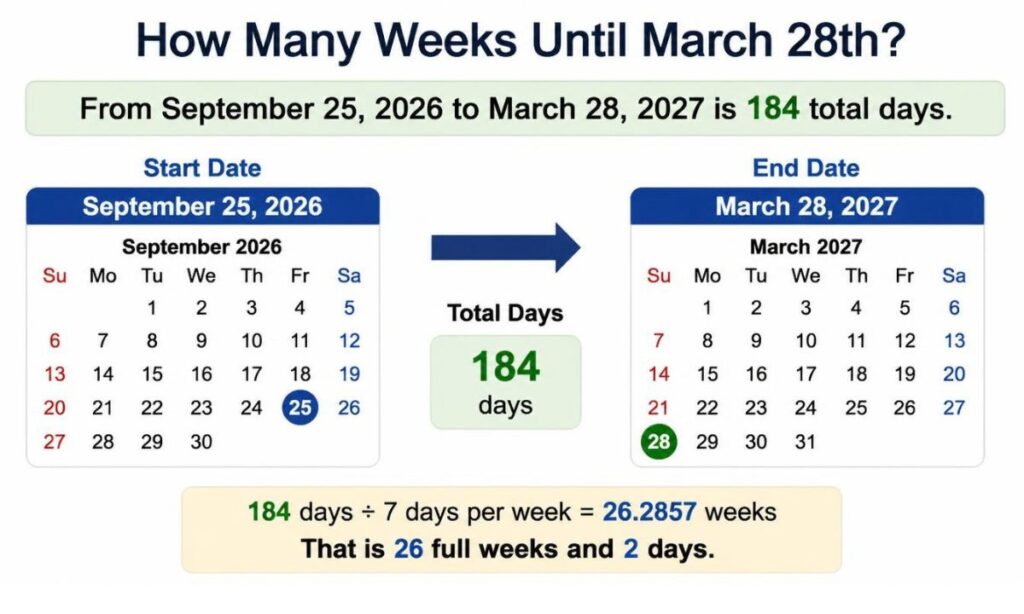
When someone searches how many weeks until March 28th, they are usually looking for a simple countdown. For the next March 28th, which is March 28, 2027, the calculation from September 25, 2026 gives 184 total days.
Divide those days by 7 days in a week:
184 ÷ 7 = 26 weeks and 2 days
So, there are 26 full weeks and 2 remaining days until March 28, 2027, when counting from September 25, 2026 and excluding the starting day. That little “2 days” at the end is easy to lose if you only look at weeks, so dont ignore it.
This is also why phrases like weeks until March 28, weeks until March 28th, and how many days until March 28 can produce slightly different-looking answers while referring to the exact same time period.
If you are using a different starting date, simply enter that date and March 28 as the start date and end date in a calculator. The result will change automatically.
Weeks Until March 28: Understanding the Countdown
A countdown to March 28th can be useful for much more than satisfying curiosity. Maybe you are planning a trip, waiting for a birthday, preparing for an examination, or counting down to a major personal event. Sometimes knowing “26 weeks and 2 days” makes a distant goal suddenly feel manageable.
A weeks between dates calculator normally takes two dates and determines the exact number of weeks between them. You select the beginning date, select March 28 as the ending date, and the tool works out the total number of days, total full weeks, and remaining days.
That is especially handy when the date range crosses different months. September becomes October, then November, December, January, February, and finally March. Doing that manually isnt impossible, but honestly, it is the sort of counting where calendars start looking suspiciously complicated.
What Does “Weeks Until March 28th” Actually Mean?
The phrase can mean slightly different things depending on what the person wants.
For example, someone may want:
- The number of weeks between today and March 28th.
- The exact number of days until March 28.
- The number of full weeks and remaining days.
- A simple March 28 countdown.
- A calculation using a particular date range.
- A calendar-based answer that respects leap years.
The safest approach is to identify the precise start date and end date first. Once those are known, the date difference becomes straightforward.
For example, from September 25, 2026 to March 28, 2027:
- Total days: 184
- Full weeks: 26
- Remaining days: 2
- Countdown: 26 weeks and 2 days
That is the kind of result a date calculation tool is designed to provide.
How a Weeks Between Dates Calculator Works
A weeks between dates calculator sounds sophisticated, but underneath the screen it is mostly doing simple calendar arithmetic. You choose the first date using a date picker, choose the second date, and press something like Calculate Weeks.
The calculator determines the date difference, converts the days into weeks, and separates complete weeks from leftover days. An online calculator is particularly convenient because it can handle different month lengths without asking you to remember whether April has 30 days or whether February has 28.
A typical result might show:
- Total number of days
- Total full weeks
- Remaining days
- The selected start date
- The selected end date
A free calculator can do all of this through an instant calculation, which saves you from doing the arithmetic by hand.
How to Calculate Weeks Until March 28 Manually
If you prefer a manual calculation, the basic idea is pleasantly simple.
First, calculate the total number of days between your start date and March 28th. Then divide the result by 7.
The basic formula is:
Weeks = Total Days / 7
If you want only complete weeks, you round down the result.
For the next March 28 example:
184 ÷ 7 = 26 remainder 2
Therefore:
26 full weeks + 2 remaining days
You can also calculate the leftover days with:
Remaining Days = Total Days – (Weeks × 7)
So:
184 – (26 × 7) = 2
There you have it. No dramatic mathematics ceremony required.
Why February Can Change the Calculation
One reason date calculations sometimes surprise people is February.
A normal calendar year has 365 days, while a leap year has 366 days. In a leap year, February contains February 29, which adds one extra day to the calendar.
That extra day can matter when your date range crosses February. If you calculate a countdown manually and forget February 29, your answer can be off by one day.
For example, a calendar year that includes February 29 needs to be treated differently from a standard year. Most modern online calculators automatically recognize the leap year, which is one reason a free calculator can be more reliable than mental counting.
March 28 and the Calendar Year
It is important to mention the year whenever possible. Saying simply March 28th does not identify one unique date.
There is a March 28 in every year, but the distance from today changes depending on which one you mean. March 28, 2026 is different from March 28, 2027, and March 28, 2028.
This becomes particularly important around the end of a year. A person searching for “how long until March 28” might mean the upcoming March 28, while another person could be referring to a specific historical or future date.
The same principle applies to other months, from January and February through April, May, June, July, August, September, October, November, and December. A date is really a combination of day, month, and year not just a number floating around by itself.
Using a Date Picker for March 28
A date picker makes this kind of calculation wonderfully simple.
Choose your start date, then choose March 28 as your end date. After clicking Calculate Weeks, the calculator handles the rest.
This is useful when you are checking a date far into the future because manually counting every month can become annoying very quickly. The tool can account for different month lengths, leap years, and the exact number of days in the selected period.
If your calculator displays both weeks and days, pay attention to both. “26 weeks” and “26 weeks and 2 days” are not quite the same thing, and those two days may matter when planning a deadline.
Calculating Weeks in Excel
You can also perform a weeks between dates calculation in Microsoft Excel. Put your start date in Cell A2 and your end date in Cell B2.
A straightforward calculation for the total number of days is:
=B2-A2
To calculate complete weeks, you can use:
=INT((B2-A2)/7)
And for remaining days:
=MOD(B2-A2,7)
These formulas are useful for project schedules, deadlines, school planning, and other situations where dates need to update automatically.
Excel’s built-in date handling can also manage leap years, so you generally don’t need to manually insert an extra day for February 29. That little bit of automation saves headaches later, especially in a spreadsheet with many dates.
Using Google Sheets for the Same Calculation
Google Sheets can handle the same type of date difference calculation.
If the starting date is in Cell A2 and the ending date is in Cell B2, you can use formulas based on the difference between the two dates.
For example:
=INT((B2-A2)/7)
returns the number of complete weeks, while:
=MOD(B2-A2,7)
returns the remaining days.
This is useful for a shared project timeline because multiple people can update dates without recalculating everything manually. A change to the end date immediately changes the result, which is rather handy when deadlines move around—as deadlines tend to do.
March 28 Countdown for Project Planning
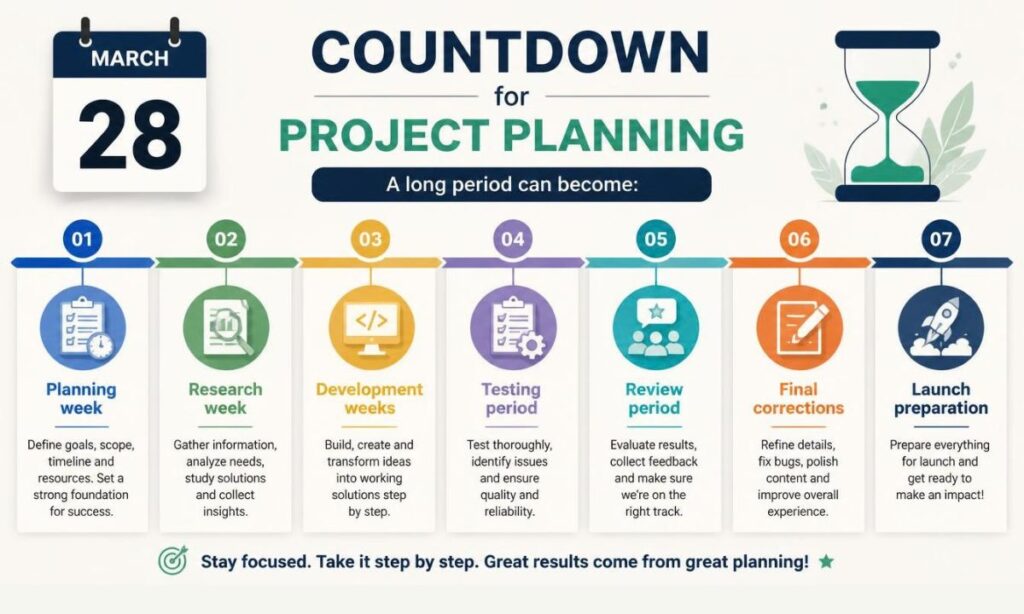
A March 28 countdown can be surprisingly helpful in project management.
Suppose a project must be finished by March 28. Instead of thinking about one giant deadline, divide the available period into smaller weekly milestones. This works particularly well for Agile development, where teams often organize work around sprints.
A long period can become:
- Planning week
- Research week
- Development weeks
- Testing period
- Review period
- Final corrections
- Launch preparation
Suddenly, “March 28” stops being a distant wall and becomes a series of smaller doors. Weirdly poetic for project management, but it works.
School and Academic Planning
Students can also use a date difference calculator for school planning and academic planning.
If March 28 marks an examination, assignment, university application deadline, or the end of a school year, knowing the exact number of weeks remaining can make a study schedule easier to organize.
Teachers can use similar calculations when preparing lesson plans, term schedules, or holiday periods. A university student might calculate the number of weeks between the beginning of a university semester and a major assessment.
Instead of saying “I have ages left,” a student can say, “I have 26 weeks and 2 days.” It somehow makes procrastination feel much more visible.
Event Planning and Personal Milestones
A future date such as March 28 can also be important for event planning, including a birthday, wedding, anniversary, party, or family gathering.
If March 28 is a birthday, you might create a weekly countdown for invitations, decorations, food, travel arrangements, and gifts. For a wedding, the same method can be used for venue preparation, guest lists, clothing, photography, and final confirmations.
The beauty of a countdown is that it turns a distant event into a sequence of small tasks. You dont need to organize the entire future today. You just need to know what belongs in this week.
Fitness and Health Goal Planning
A date countdown can also support a fitness program or training plan.
Suppose someone begins a 12-week fitness program and wants to know whether it finishes near March 28. The date difference can show exactly how many complete weeks are available and whether there are a few extra days at either end.
The same principle can be used for a diet challenge, running plan, strength program, or another personal goal.
The number itself is not magic, of course. It is simply a planning boundary. What matters is how you use the time between today and the chosen date.
Financial Planning and Deadlines
Dates matter a lot in financial planning too.
People may need to count weeks until:
- Payroll dates
- Salary payments
- Rent due dates
- Loan repayments
- Payment terms
- Contract deadlines
- Notice periods
- Legal deadlines
- Appeal windows
In these situations, precision matters more than a rough “about four months.” A difference of a few days can affect when an obligation becomes due.
For anything legally binding, however, always check the actual contract, official notice, or applicable rules rather than relying only on a general date calculator. A calculator tells you the calendar difference; it does not interpret legal requirements.
Date Calculation and Inclusive Counting
One small issue causes a surprising amount of confusion: whether to exclude the start date or include the end date.
Suppose you count from September 25 to March 28. One method calculates the elapsed time by excluding the starting day. Another counting convention may include both endpoints.
That is why two sources can occasionally show slightly different day counts while appearing to calculate the same dates.
For ordinary “how many weeks until” questions, elapsed-time calculations generally use the difference between the two dates. But if you are working with a formal deadline, contract, notice period, or legal window, check the specific counting rule that applies.
ISO 8601 and Week Numbers
Another calendar concept you may encounter is ISO 8601.
The ISO 8601 standard provides conventions for representing dates and weeks. Under the ISO week system, weeks begin on Monday, and the first week of an ISO year is defined according to specific calendar rules.
That means an ordinary calendar date and its ISO week number are related but not identical concepts. A date may fall in Week 01, Week 52, or occasionally Week 53, depending on the year.
For everyday countdowns, you usually don’t need ISO week calculations. But for international business, software systems, schedules, and data management, ISO 8601 can be very useful.
Why a Countdown Is More Than a Number
There is something almost emotional about counting toward a date.
A person waiting for March 28 might be waiting for a holiday. Someone else might be waiting for a new job to begin. Another person may have a birthday circled in bright ink. Someone somewhere might simply like the quiet satisfaction of watching a number become smaller.
That is why how many weeks until March 28th is more than a mathematical question. The number provides structure to the waiting.
Twenty-six weeks can sound enormous. Two days can sound tiny. Put them together, though, and you have a very specific amount of time: 184 days.
And knowing that can change how you plan every ordinary Tuesday between now and then.
Quick Reference for March 28
For the calculation from September 25, 2026 to March 28, 2027:
| Calculation | Result |
|---|---|
| Start date | September 25, 2026 |
| End date | March 28, 2027 |
| Total number of days | 184 |
| Full weeks | 26 |
| Remaining days | 2 |
| Total period | 26 weeks and 2 days |
This is the answer for that specific date range. If your starting date is different, the result will naturally change.
How to Make Your March 28 Countdown More Useful
Instead of only asking “how many weeks until March 28,” try turning the answer into a small planning system.
For example, if you have 26 full weeks, assign a purpose to each block of time. The first few weeks might be for preparation, the middle weeks for active work, and the final weeks for checking details.
For a personal goal, write one small milestone for each week. For an event, create a checklist. For school, divide chapters or assignments across the available weeks. For a trip, use the early weeks for bookings and the final weeks for packing and confirmations.
A countdown becomes useful when it changes what you do today.
Frequently Asked Questions
How many weeks until March 28th?
From September 25, 2026 to March 28, 2027, there are 26 full weeks and 2 days, or 184 days in total.
How many days until March 28?
Using September 25, 2026 as the starting date and March 28, 2027 as the ending date, the difference is 184 days.
How do I calculate weeks until March 28 manually?
Calculate the total number of days between your start date and March 28, then divide by 7. The quotient gives full weeks and the remainder gives remaining days.
Can I calculate the countdown in Excel?
Yes. If your start date is in A2 and your end date is in B2, =INT((B2-A2)/7) can return complete weeks, while =MOD(B2-A2,7) returns remaining days.
Does a leap year affect the answer?
Yes, when the date range crosses February in a leap year. A leap year has 366 days and includes February 29, while a normal year has 365 days.
Conclusion
So, how many weeks until March 28th? Using September 25, 2026 as the starting point, the next March 28 March 28, 2027 is 26 weeks and 2 days away, or 184 days.
But a date calculation can be more useful when you treat it as a planning tool rather than just a number. Whether March 28 represents a birthday, deadline, holiday, trip, academic milestone, fitness target, or another important moment, the weeks between now and then can be divided into smaller pieces that feel much easier to handle.
Use a weeks between dates calculator when you want speed, a spreadsheet when you want repeatable planning, or a manual calculation when you want to understand the mathematics behind the answer. The method is simple: identify the start date, identify the end date, find the total number of days, and divide by seven.
And perhaps that is the nicest thing about a countdown: March 28 may feel far away today, but every week that passes quietly removes another piece of the distance. Before you notice it, the future date becomes today and the little calendar question becomes a memory of something you once waited for.