There is something oddly satisfying about putting a future date on the calendar and watching the blank space between today and that day slowly disappear. If you have been wondering how many weeks until May 30th, the answer depends on the year and the start date you are counting from. As of October 3, 2026, the next May 30th is May 30, 2027, which is 34 weeks and 1 day away, or 239 calendar days in total. Thats the simple answer, but dates have a funny habit of becoming complicated when you start asking about hours, working days, weekends, time zones, and whether the starting day should be included.
Maybe May 30th is connected to a holiday, vacation, birthday, wedding, family gathering, school milestone, or simply a personal deadline you have circled in your planner. Whatever the reason, knowing the exact time until May 30 can make planning feel much easier. Instead of saying “sometime near the end of May,” you can work with a clear date duration, a measurable time span, and a proper countdown.
How Many Weeks Until May 30th From Today?
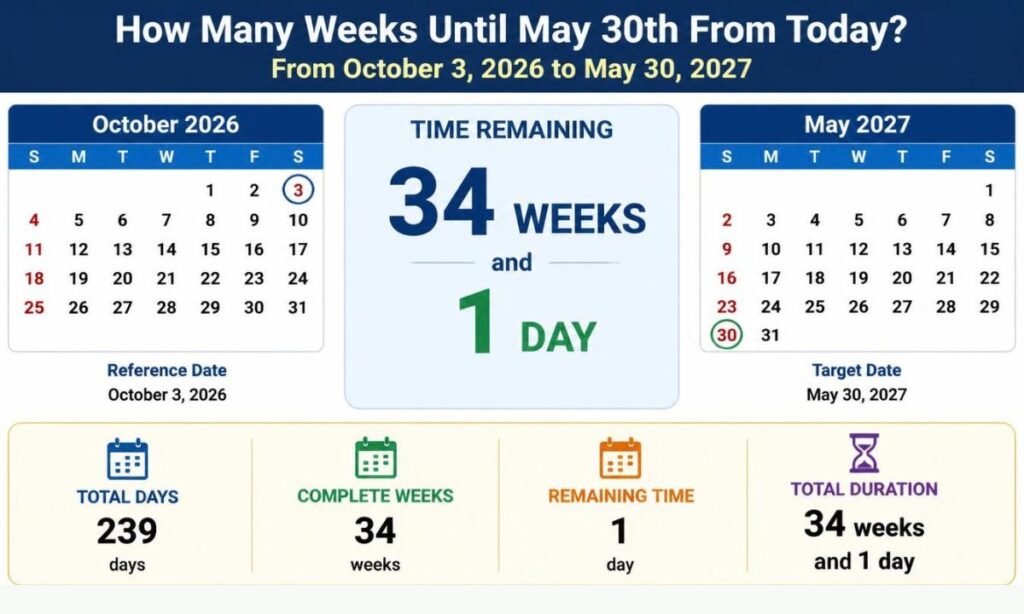
If today is October 3, 2026, and the target calendar date is May 30, 2027, there are 239 days between the two dates. Dividing 239 by the standard 7-day week gives 34 complete weeks with 1 day remaining. So, the answer to how many weeks until May 30th is 34 weeks and 1 day.
The calculation looks very simple on paper, but it is worth remembering that “weeks until a date” is not always the same thing as “calendar weeks.” A 7-day week is a fixed unit, while calendar systems can display weeks differently depending on the convention being used. For an ordinary countdown, however, dividing the number of calendar days by seven is usually exactly what people mean.
Quick Answer
- Target date: May 30, 2027
- Reference date: October 3, 2026
- Total days: 239 days
- Complete weeks: 34 weeks
- Remaining time: 1 day
- Total duration: 34 weeks and 1 day
So if you are checking the weeks remaining until May 30, you have a little over 34 weeks to go. It sounds long, then suddenly May arrives and everybody starts asking where the time went.
How Many Days Until May 30?
Another common version of the question is how many days until May 30. From October 3, 2026, until May 30, 2027, the answer is 239 days when counting the elapsed calendar-day difference between the two dates.
This is where a date difference calculator can be useful. You enter the start date and end date, and the tool performs the underlying date arithmetic instead of making you count through each month manually. It is especially handy when the date range crosses several months, because nobody really wants to sit there counting October, November, December, January, February, March, April, and May on their fingers.
The result can also be expressed in different units:
- 239 days
- 34 weeks and 1 day
- 5,736 hours
- 344,160 minutes
- 20,649,600 seconds
Those smaller units are mathematically useful, although saying “20 million seconds until May 30” sounds a little dramatic for a normal calendar countdown, honestly.
A Simple May 30 Countdown
A countdown to May 30 is basically a way of converting a future date into smaller, easier-to-understand pieces of time. Instead of looking at a calendar and guessing how far away the date feels, a countdown tells you the measurable distance between two points.
For example, if you are preparing for an event on May 30, you might divide your planning into stages. You could use the first several weeks for research, another period for preparation, and the final few weeks for checking details. This turns a large date range into a series of smaller milestones, which can feel much more manageable.
A countdown can be used for:
- Vacation planning
- Wedding planning
- Birthday preparation
- Academic deadlines
- Exam countdowns
- Project management
- Assignment deadlines
- Contract renewals
- Savings goals
- Special events
- Travel arrangements
- Personal milestones
The date itself does not need to be emotionally important. Sometimes people just like knowing exactly how much time is left. Calendars are weirdly comforting like that.
How to Calculate Weeks Until May 30th Manually

You do not need a complicated formula to calculate weeks until May 30th. The basic method is straightforward.
First, determine your start date and your end date. The start date is the day you are counting from, while the end date is May 30. Then calculate the total number of calendar days between those dates.
Once you have the total number of days, divide it by seven:
Total days ÷ 7 = weeks
For the October 3, 2026 to May 30, 2027 example:
239 ÷ 7 = 34 weeks with 1 day remaining
That gives you the exact whole-week result without rounding the remaining day away.
The calculation becomes slightly more annoying when people are working across several months with different lengths. May itself has 31 days, April has 30, March has 31, and February can have either 28 or 29. So yes, the calendar is basically doing tiny tricks behind your back.
Weeks and Days Between Two Dates
When people search for the exact weeks between dates, they often expect a result that includes both complete weeks and leftover days. This is more useful than simply getting a decimal such as 34.14 weeks.
For example, saying “34 weeks and 1 day” immediately communicates the duration. A decimal result may be mathematically correct, but it is less natural for everyday planning.
A good weeks calculator can therefore provide:
- Total weeks
- Remaining days
- Total days
- Total hours
- Total minutes
- Total seconds
This is particularly helpful when comparing two future dates, checking a project timeline, or figuring out how much time remains before a personal event.
Why the Start Date and End Date Matter
One of the easiest ways to get different answers from a date calculation is to change whether the dates are inclusive dates or exclusive dates.
An inclusive calculation may count the starting or ending date as part of the range, while an exclusive calculation may measure only the elapsed time between the two dates. Neither approach is automatically wrong; the important thing is knowing which method your calculator uses.
For ordinary questions like “how many weeks until May 30th,” people generally mean the elapsed time from today to the target date. That is why a standard date difference calculation gives 239 days for October 3, 2026 to May 30, 2027.
If you are calculating legal deadlines, contracts, payment periods, or official schedules, however, the exact counting convention can matter alot.
Calendar Days vs. Business Days
There is a big difference between calendar days and business days. Calendar days include every day on the calendar, including Saturdays and Sundays. Business days or working days normally focus on weekdays, although the exact definition can vary by organization or country.
Suppose you have 34 weeks and 1 day until May 30. That does not mean you necessarily have 239 working days available. Weekends need to be removed, and certain public holidays may also affect the total.
A business days calculator can be useful when planning:
- Employee schedules
- Project deadlines
- Contract periods
- Payment schedules
- Government submissions
- Academic work
- Office deadlines
For a simple personal countdown, though, calendar days are usually enough. There is no reason to make a birthday countdown behave like a corporate spreadsheet.
How Many Weeks Until May 30 for Planning?
Knowing how many weeks until May 30 becomes especially useful when the date represents a real goal. A deadline that looks distant today can suddenly become very close when several weeks have passed.
If you have 34 weeks available, you can break that period into manageable sections. The first stage could be preparation, the middle stage could be active work, and the final weeks could be reserved for finishing touches.
For a major event, you might create milestones such as:
- 30 weeks before May 30: establish the overall plan
- 24 weeks before: complete early research
- 20 weeks before: confirm major decisions
- 12 weeks before: begin detailed preparation
- 8 weeks before: review outstanding tasks
- 4 weeks before: finalize important arrangements
- 1 week before: check everything one last time
A timeline like this makes a distant date feel less like a giant wall and more like a collection of small steps.
Using a Free Online Date Calculator
A free online calculator can calculate the weeks between dates almost instantly. Most date tools ask you to select a start date and an end date, then display the difference in several units.
A useful date duration calculator may offer features such as:
- Exact calculation
- Instant results
- Real-time calculation
- Quick presets
- Multiple time units
- Calendar-day calculations
- Business-day options
- Inclusive or exclusive dates
- Mobile-responsive design
- No registration
- No downloads
- No hidden fees
The advantage is mostly convenience. You could calculate a date range manually, but if a tool can do it in seconds, there is not much glory in fighting with a calendar for twenty minutes.
Date Arithmetic and the Gregorian Calendar
Most modern everyday date calculations use the Gregorian calendar, the calendar system widely adopted internationally. Its history goes back to the calendar reform associated with Pope Gregory XIII in 1582.
Before that, the Julian calendar, associated with Julius Caesar, was used in many places. The difference between calendar systems is historically important, but modern date calculators generally use the Gregorian system unless another calendar is specifically requested.
The Gregorian calendar contains months with 28, 29, 30, or 31 days. February is the unusual one, having 28 days in a normal year and 29 during a leap year.
This matters when performing precise date arithmetic across February. A date range crossing February 29th can produce a different duration than the same-looking range in a non-leap year.
What Is a Leap Year?

A leap year calculation is important for accurate date differences. In the Gregorian calendar, a year is generally a leap year when it is divisible by four, except for most century years unless they are also divisible by 400.
That sounds more complicated than it needs to be, but thankfully modern calculators handle it automatically.
For example, 2028 is a leap year and contains February 29th, while 2027 does not. If your date range crosses February, this extra day can change the final number of weeks and days between dates.
For the October 3, 2026 to May 30, 2027 calculation, there is no February 29th involved because 2027 is not a leap year.
Time Zones and Exact Time Differences
A date-only calculation is different from an exact time calculation. If you ask for the number of days between two calendar dates, the result is usually based on the dates themselves. If you ask for the exact number of hours between two timestamps, time zones and daylight saving time can become important.
For example, a clock can move forward or backward because of daylight saving rules in locations that observe them. That means two local timestamps spanning a transition may not represent exactly the same number of clock hours as their calendar-day difference might suggest.
A precise time difference calculation may therefore consider:
- Local browser time
- Time zones
- Daylight saving time
- Hours
- Minutes
- Seconds
- Standardized time units
For most “how many weeks until May 30” searches, this level of precision is unnecessary. The calendar date is usually the thing that matters.
Official Time Standards and Date Accuracy
For applications that require highly precise time measurement, organizations such as the National Institute of Standards and Technology (NIST) provide official time-related standards and information. NIST is also associated with precise timekeeping and atomic-clock-based measurements.
Standards such as ISO 8601 provide internationally recognized ways to represent dates and times. These standards become particularly useful in software, databases, scientific work, international communication, and systems where ambiguity about dates could cause real problems.
For everyday planning, you probably do not need to think about atomic clock synchronization while counting down to May 30. Still, it is useful to know that modern timekeeping is built on much more precise foundations than simply looking at the wall clock.
Practical Uses for a May 30 Countdown
There are plenty of reasons someone might search how many weeks until May 30th. The date could be connected to something personal, professional, academic, or financial.
Vacation Planning
A May 30 vacation gives you a clear target for booking transportation, organizing accommodation, preparing documents, and making a packing list. A vacation countdown can also help you divide preparation into smaller tasks.
Wedding Planning
Wedding preparation often involves dozens of deadlines. Knowing the number of weeks remaining until May 30 can help couples organize invitations, venues, outfits, photography, travel, and final arrangements without trying to do everything during the last few days.
Academic Deadlines
Students can use a date countdown calculator to measure their study period. If an exam or assignment deadline falls on May 30, the number of weeks available can be divided into revision blocks, practice sessions, and final review.
Project Management
A May 30 deadline can become a useful project timeline. Teams can identify milestones, assign responsibilities, and track progress according to the weeks remaining.
Savings Goals
If you are saving money for something planned around May 30, knowing the number of weeks left lets you divide your target amount across the remaining period. Suddenly the big number becomes a smaller weekly goal, which feels much less scary.
Related Date Calculators You May Find Useful
A person searching for how many weeks until May 30 may also need another type of date tool. Different calculators answer slightly different questions.
A days between dates calculator focuses on the total number of days in a date range. A business days calculator removes weekends and may account for holidays. An age calculator determines age based on birth and target dates.
Other useful tools include:
- Date duration calculator
- Work hours calculator
- Pregnancy week calculator
- Weeks calculator
- Time calculator
- Date difference tool
- Date interval calculator
- Deadline calculator
- Working day calculator
Choosing the right calculator is important because “how much time” can mean different things depending on the situation.
How to Make a Date Countdown More Useful
A countdown becomes much more valuable when you connect it with action. Simply knowing there are 34 weeks and 1 day until May 30 is interesting, but turning those weeks into milestones is where the practical benefit appears.
Start by writing the target date clearly. Then list the things that must happen before it. Give each task its own approximate deadline, and leave a little breathing room for unexpected delays.
You can also create weekly checkpoints. Every seven days, ask what has been completed, what is still waiting, and whether the original timeline needs adjusting. It sounds almost too simple, but simple systems are often the ones people actually keep using.
Explore More Blogs : How Many Weeks Until May 26?
Frequently Asked Questions
How many weeks until May 30th?
From October 3, 2026, until May 30, 2027, there are 34 weeks and 1 day, equal to 239 calendar days. The result changes if you use a different starting date or a different year.
How many days until May 30?
Using October 3, 2026 as the starting date, there are 239 days until May 30, 2027. This is the standard elapsed calendar-day difference.
How many weeks and days are between October 3 and May 30?
The date range from October 3, 2026 to May 30, 2027 contains 34 complete weeks and 1 additional day. Thats often the easiest format for everyday planning.
Does the answer change every year?
Yes. May 30 occurs every year, but the number of days between your starting date and May 30 changes depending on the year and the starting point. Leap years can also affect certain date ranges.
Can I calculate business days until May 30?
Yes. A business days calculation can exclude weekends and, depending on the tool, holidays. The result will be different from the total number of calendar days.
Does May 30 always fall on the same weekday?
No. The weekday changes from year to year. The calendar date stays May 30, but its position within the weekly cycle shifts.
Conclusion
So, how many weeks until May 30th? If today is October 3, 2026, the next May 30 is May 30, 2027, and the distance is 34 weeks and 1 day, or 239 days. That gives you a clear starting point whether you are planning a trip, preparing for an event, organizing a project, studying for an exam, or simply satisfying that little calendar question that popped into your head.
The nicest thing about a future date is that it gives ordinary days a bit of shape. One week becomes another, then another, and eventually the date that once looked far away is sitting right there on the calendar. A good date calculator makes the arithmetic easier, but the reason you are counting is always the interesting part.
If May 30 means something special to you, turn those weeks remaining until May 30 into useful milestones instead of watching the countdown pass by. Write down what needs to happen, give yourself realistic deadlines, and leave a little room for life to be life. Calendars are precise; people, thankfully, are not.
And if you have a favorite way to count down to an important date, share it. Maybe your method is a calendar, a phone reminder, a weekly checklist, or just that slightly chaotic habit of announcing “only three months left!” to everyone around you. Whatever works, May 30 will arrive when the calendar says it will, one day at a time.