There is something oddly comforting about looking at a calendar and wondering, how many weeks until September 13? A date can sit quietly on a page for months, yet somehow it starts feeling closer the moment we give it a name. Maybe September 13 is a birthday, a family celebration, a school milestone, a trip, or even the day a family hopes to welcome a precious baby girl into the world. Whatever the reason, counting the weeks can make a far-away moment feel a little more real, and a little less mysterious.
If you are checking the countdown from September 28, 2026, the next September 13 is September 13, 2027. There are 350 days, which equals exactly 50 full weeks. Thats a wonderfully neat number because there are no leftover days in this particular calculation. Of course, if your start date is different, the answer will change, so using the right dates is important when you want an exact number of weeks.
A simple weeks between dates calculator can do this instantly. You choose the start date, select the end date, and the calculator gives you the total full weeks and any remaining days. It is much easier than staring at twelve months of calendar boxes and wondering whether you accidentally counted one day twice.
How Many Weeks Until September 13 From September 28, 2026?
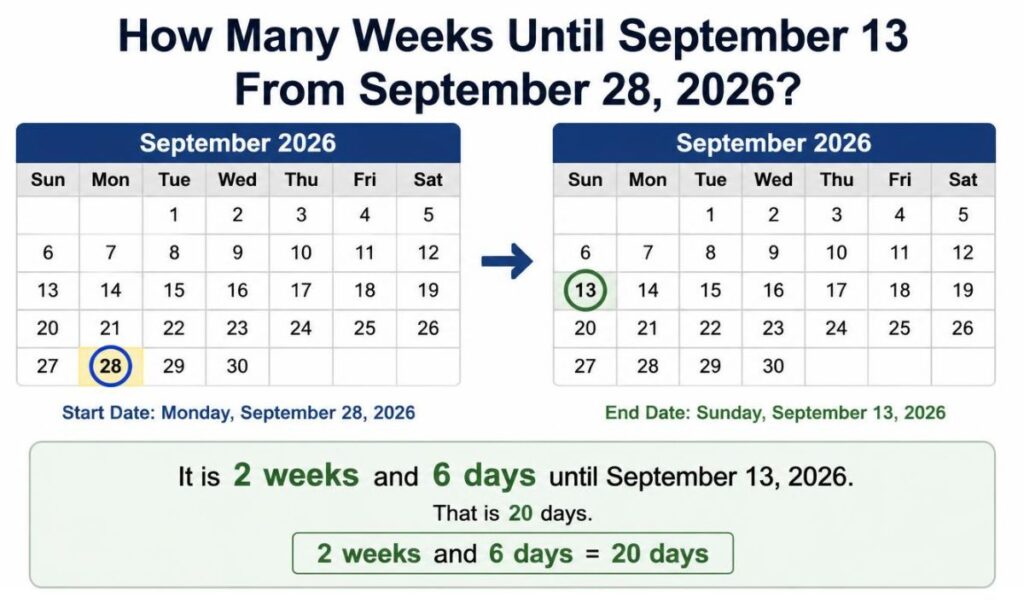
From September 28, 2026, to September 13, 2027, the date difference is 350 days. Since there are 7 days in a week, dividing 350 by 7 gives 50 weeks. So, the simple answer is:
September 28, 2026 → September 13, 2027 = 50 weeks
That means the September 13 countdown has exactly 50 weeks from the current date used in this example. No leftover days are hiding at the end, which makes this one unusually tidy date calculation, honestly.
The calculation can be written like this:
Weeks = Total Days / 7
350 ÷ 7 = 50
So there are 50 full weeks between these two dates when counting the elapsed time from September 28, 2026 to September 13, 2027.
It is worth remembering that a countdown depends entirely on the dates you enter. If you check this article on another day, the answer to weeks until September 13 will naturally be different. A countdown is a moving number, not a permanent fact carved into the calendar.
Why September 13 Can Be an Important Date
A date becomes meaningful because of what happens on it, not because the calendar says it is special. September 13 might mark a birthday, anniversary, holiday, exam, vacation, project deadline, or family gathering. Sometimes it can even be a quiet target date for something personal that nobody else knows about yet.
For parents and grandparents, a September date can also become part of a beautiful family story. Imagine a family preparing for the arrival of a baby girl around this time. The weeks before her arrival may be filled with tiny clothes, late-night conversations, nursery preparation, name ideas, and the slightly chaotic joy that comes with waiting for someone who has not even arrived yet.
That is why time remaining can feel emotional as well as mathematical. Fifty weeks sounds like a large stretch of time, but when the date represents something important, those weeks can seem to disappear surprisingly fast.
How to Calculate Weeks Until September 13
There are several ways to calculate weeks between dates, depending on how precise or convenient you want the process to be. The simplest method is to find the total number of days in the date range and then divide that number by 7.
For example, if the day count is 350:
350 ÷ 7 = 50 weeks
When the number does not divide evenly, you can round down to find the full weeks, then report the leftover amount separately. For instance, 352 days would equal 50 full weeks with 2 remaining days.
The formula is:
Weeks = Total Days / 7
And for the leftover part:
Remaining Days = Total Days - (Weeks × 7)
This method is useful when doing a manual date calculation, but a calculator is usually quicker. Human beings are excellent at celebrating dates and surprisingly bad at counting calendar squares after lunch.
Use a Weeks Between Dates Calculator
A weeks between dates calculator is useful when you want the exact weeks between two dates without doing all the arithmetic yourself. Most online tools use a date picker, allowing you to select both dates rather than typing them manually.
A typical process looks like this:
- Choose your start date.
- Choose September 13 as the end date.
- Click calculate weeks.
- Check the total full weeks.
- Check the remaining days.
- Review the total number of days.
- Use the result for your countdown or planning.
A free online calculator is especially handy when the dates cross several months. Going from September into October, November, December, and then into the next year means the month lengths have to be handled correctly. A calculator takes care of those details without making you remember which month has 30 days and which one has 31.
How Many Weeks and Days Until September 13?
Sometimes people do not only want to know the number of weeks. They want the complete answer: how many weeks and days until September 13?
The answer depends on the starting point. Using September 28, 2026 as the starting date, the interval is exactly 50 weeks and 0 days.
If your own starting date produces a number such as 50 weeks and 3 days, that means the interval contains 50 complete seven-day periods plus three additional days. This is why a weeks and days calculator can be more useful than simply converting everything into weeks.
The distinction matters when you are making a detailed schedule. A three-day difference might not matter for casual curiosity, but it can matter quite a lot for a work deadline, payment date, school event, or travel booking.
Understanding Calendar Months and Week Calculations

The calendar does not divide itself into neat blocks of four weeks. January has 31 days, February has 28 days in a standard year or 29 days in a leap year, and March has 31. Then come April, May, June, July, August, September, October, November, and December, each with their own number of days.
A common mistake is assuming every month contains exactly four weeks. Four weeks equals only 28 days, so a 30-day month has two extra days and a 31-day month has three extra days. Those little leftovers accumulate when you are calculating a long date interval.
A standard year contains 365 days, while a leap year contains 366 days. That works out to 52 full weeks plus 1 day in a standard year, or 52 full weeks plus 2 days in a leap year. Some calendar systems also discuss 53 weeks, depending on how the days line up and which week-numbering convention is being used.
Manual Date Calculation Across Different Months
If you want to calculate the number of weeks between two dates manually, you first need to establish the number of days between the dates. This can be done by adding the remaining days in the starting month, complete months in between, and the days reached in the ending month.
For a long period such as September 28, 2026 to September 13, 2027, this involves moving across multiple months. You need to account for September, October, November, December, January, February, March, April, May, June, July, August, and part of September. It is perfectly doable, but it is also exactly the sort of job a calculator was invented for.
When accuracy matters, remember whether you are using inclusive dates or an elapsed-time calculation that uses an excluded start date and an included end date. Different counting conventions can produce different-looking answers, even when the dates themselves are identical.
How to Calculate Weeks in Microsoft Excel
If you regularly work with deadlines, schedules, or dates, Microsoft Excel can handle much of the calculation automatically. Suppose your start date is entered in cell A2 and your end date is entered in cell B2.
A basic full-weeks formula can be written as:
=INT((B2-A2)/7)
This returns the number of complete seven-day periods between the two dates. The INT function effectively removes the decimal portion, giving you the full weeks rather than a partial week.
You can also use the MOD function when you want to identify the leftover days. This is handy for creating a spreadsheet that displays something like “50 weeks and 2 days” rather than only showing a decimal number.
Excel is especially useful for project management, weekly milestones, work deadlines, payroll planning, and recurring schedules. Once the dates are entered, changing either date updates the calculation automatically, which saves quite a bit of repetitive work.
How to Calculate Weeks in Google Sheets
Google Sheets offers similar functionality and is convenient when several people need to work on the same schedule. Enter the starting date in one cell and the ending date in another, then use a formula to determine the number of complete weeks.
For example:
=INT((B2-A2)/7)
The result provides the full weeks between the two dates. A separate calculation can be used for remaining days if you need the complete weeks-and-days format.
This can be useful for a shared project timeline, school calendar, event schedule, training plan, or even a family countdown. A spreadsheet may sound terribly serious for counting toward September 13, but sometimes serious spreadsheets are secretly just very organized excitement.
Planning Projects Around September 13

A date countdown can be much more useful when connected to a real goal. If September 13 is a deadline, you can divide the available time into smaller weekly targets instead of treating the entire period as one giant block.
In project management, for example, 50 weeks could be divided into research, development, testing, revision, and launch stages. Teams using Agile development might organize the work into Agile sprints, while other teams may use weekly milestones and monthly checkpoints.
A simple countdown can also help with:
- Project management
- Weekly milestones
- Work deadlines
- Product launch planning
- Event planning
- Wedding planning
- Trip planning
- Preparation goals
- Progress tracking
- Financial planning
The main advantage is psychological as much as practical. “September 13 is 350 days away” feels abstract. “I have 50 weekly milestones to complete” gives the calendar a shape, and shape makes planning easier.
School and Academic Planning
Students can also use weeks until September 13 as part of school planning or academic planning. A semester can be divided into weekly study targets, assignment deadlines, reading goals, and revision periods.
Teachers may use similar calculations when preparing lesson plans, assessments, classroom projects, or school events. Universities can use date intervals for a university semester, registration periods, examinations, and breaks.
If September 13 marks the beginning of an important academic period, knowing the number of weeks beforehand can help create a realistic study schedule. Fifty weeks is enough time for many goals, but only if those weeks do not all become “I’ll start next Monday,” because that particular Monday is mysteriously always busy.
Fitness, Training, and Personal Goals
A countdown can also turn a distant goal into manageable pieces. If September 13 is your target date, you might create a fitness goal, training plan, diet challenge, or progress-tracking schedule based on weekly intervals.
For example, a person preparing for an event could divide the period into conditioning, strength, endurance, recovery, and final preparation. Someone working toward a personal milestone might review progress every seven days rather than waiting until the final date.
The exact structure depends on the goal, but the principle stays the same: a long time interval becomes easier to manage when it is broken into smaller weekly sections.
Financial and Work-Related Date Planning
Dates matter in money management too. Businesses may need to track payment terms, rent payments, loan repayments, weekly salary, payroll periods, or contract milestones.
A company could use a date calculator to determine how many weeks remain before a payment deadline. Someone handling a contract may need to monitor notice periods, legal deadlines, or appeal windows.
For these situations, accuracy is especially important. A casual countdown can tolerate a small misunderstanding, but a financial or legal date should always be checked against the actual agreement, official notice, or applicable rules. A calculator helps with arithmetic, but it does not replace the document that establishes the deadline.
International Week Standards and ISO 8601
Week numbering becomes slightly more complicated when working across countries or organizations. ISO 8601 is an international date and time standard that defines a particular approach to calendar dates and week numbering.
Under the ISO week standard, weeks generally begin on Monday, and week 01 is associated with the week containing the year’s first Thursday. This means the first days of January can sometimes belong to the final ISO week of the previous calendar year.
Other systems use different conventions, including a Sunday-start week. Businesses involved in international logistics, international scheduling, or global business planning may need to know which convention their system uses.
The distinction does not change the elapsed number of days between September 28, 2026 and September 13, 2027, but it can change how a particular calendar labels the weeks. Thats a small distinction with surprisingly big consequences in spreadsheets and reporting.
Australian Financial and School-Year Planning
Australian users may encounter another important date structure when planning across the calendar year. The Australian financial year runs from July 1 through June 30 of the following year.
For example, AU Financial Year 2026–27 runs from July 1, 2026 through June 30, 2027, often referred to as FY2027 in financial contexts. A September date therefore falls within that financial year.
Families may also use an Australian school term calendar rather than the standard January-to-December planning approach. Specific school dates vary by state and territory, so an AU School Term 1 2026 schedule should be checked against the relevant education authority rather than assumed from a generic calendar.
This is a good reminder that date calculations are mathematical, while the meaning attached to dates can be geographic and institutional.
September 13 Countdown for a Special Family Moment
Sometimes a countdown is not about work or spreadsheets at all. Maybe September 13 is the day a family is planning a special gathering, birthday celebration, anniversary, or a welcome-home moment for a new baby girl.
When a daughter joins a family, even a simple message can carry a surprising amount of emotion. Grandparents might write a note about tiny hands and enormous possibilities. An aunt may send something playful. A parent may simply say that the house already feels different, even before the baby has learned to recognize the sound of everyone’s voice.
Here are a few adaptable wishes for that kind of moment:
- “May your little girl fill your home with laughter, sleepy cuddles, and the kind of happiness that sneaks up on you.”
- “A daughter is a tiny new chapter with a very big place in the heart.”
- “Wishing your family endless newborn snuggles and beautiful memories with your precious baby girl.”
- “May her little footsteps lead your family toward years of joy, discovery, and unforgettable adventures.”
- “Congratulations on welcoming your beautiful daughter. May every ordinary day become a memory worth keeping.”
- “A baby girl has arrived, and suddenly the future feels a little brighter.”
- “May your daughter grow surrounded by patience, kindness, laughter, and people who cheer for her loudly.”
- “Sending warm wishes for peaceful nights, happy mornings, and a lifetime of beautiful moments together.”
Warm Messages for Parents and Grandparents
For grandparents, welcoming a granddaughter can feel like watching a familiar family story begin a completely new chapter. The emotions are often a strange mixture of nostalgia and excitement, because they remember their own children being tiny and now another generation is arriving.
Some messages can be simple, because not every heartfelt thought needs a paragraph long enough to require its own coffee break:
- “Congratulations on your beautiful granddaughter. May she bring a fresh kind of joy into every corner of your family.”
- “Your little girl is lucky to have so much love waiting for her.”
- “May your granddaughter’s life be filled with gentle beginnings and brave adventures.”
- “A granddaughter adds a new sparkle to the family story. Wishing you countless precious moments together.”
- “May every cuddle, smile, and sleepy yawn become one of those memories you never stop talking about.”
- “Welcome to a lifetime of pink little socks, sweet smiles, and wonderfully unexpected moments.”
- “Your family has grown by one tiny person and somehow by a whole universe of love.”
- “May this new little girl grow knowing just how deeply she is loved from her very first days.”
Making Your September 13 Countdown More Useful
Instead of checking the September 13 countdown once and forgetting about it, turn the number into something actionable. If there are 50 weeks, create 50 small milestones. Each week can have one task connected to the bigger goal.
For a birthday, that might mean planning one part of the celebration each week. For a trip, it could mean booking transportation, choosing accommodation, preparing documents, and organizing activities. For a school goal, it could mean completing a particular amount of study each week.
You can also mark every seventh day on a wall calendar. Seeing the countdown physically shrink can be oddly satisfying, especially when the date feels far away at first. The calendar slowly changes from “someday” to “almost here,” which is one of the nicer tricks time plays on us.
What If September 13 Has Already Passed?

If today’s date is after September 13 in the same calendar year, then September 13 is a past date, not a future date. In that case, you may want to calculate how many weeks have passed since September 13 rather than how many weeks remain until it.
A good date calculator should work in both directions. You can enter a past date as the starting point and a current date as the ending point, or reverse the order depending on how the tool displays results.
This is particularly helpful for anniversaries, completed projects, historical milestones, and progress tracking. The same mathematics works whether you are looking backward or forward.
Inclusive and Exclusive Date Counting
One of the most common sources of confusion in date arithmetic is whether the starting day itself is counted. There is a difference between elapsed time and inclusive calendar counting.
For example, a calculator may treat the excluded start date as the beginning of the interval and count elapsed days until the included end date. Another method may count both dates as calendar days.
Neither approach is automatically wrong; they simply answer slightly different questions. When you need an exact date calculation for a legal, financial, or official purpose, check the counting convention being used.
For ordinary “how long until” questions, elapsed time is generally the most intuitive approach.
A Simple Way to Remember the Calculation
When all the calendar details start becoming a bit tangled, remember one tiny rule:
One week = 7 days.
So if you know the total days, divide by 7 to get the number of weeks. If there is a remainder, that remainder is the number of leftover days.
For example:
365 days ÷ 7 = 52 weeks + 1 day
And:
366 days ÷ 7 = 52 weeks + 2 days
This explains why saying that a year contains “52 weeks” is useful but not perfectly complete. There is usually an extra day, and a leap year has two. Calendar math likes leaving little surprises in the margins.
Frequently Asked Questions
How Many Weeks Until September 13 From Today?
The number of weeks depends on your current date, but a date calculator can quickly show the exact weeks and remaining days.
How Many Days Until September 13?
You can calculate the total days until September 13 by comparing today’s date with September 13 as the end date.
How Do You Calculate Weeks Until September 13?
Divide the total number of days by 7 to find the full weeks, then use any leftover days as the remainder.
Can I Use a Weeks Between Dates Calculator?
Yes, an online weeks calculator makes it easy to enter your start and end dates and instantly find the exact date difference.
Conclusion
So, how many weeks until September 13? From September 28, 2026, the next September 13 falls on September 13, 2027, which is 350 days away, or exactly 50 weeks.
If you are checking the answer from a different current date, use your own start date and September 13 as the end date. A weeks calculator, date difference calculator, or weeks between dates calculator can provide the result quickly, including full weeks, remaining days, and the total number of days.
More importantly, a countdown can be more than a number. It can help organize a project, prepare for a semester, track a fitness goal, plan a wedding, schedule a trip, manage finances, or simply look forward to a beautiful family occasion.
And if September 13 represents the arrival or celebration of a baby girl, the number becomes even sweeter. Fifty weeks is no longer just 350 days on a calendar; it becomes 50 little chapters of preparation, anticipation, laughter, planning, and hope. Dates eventually arrive whether we are ready or not, but counting the weeks gives us a chance to notice the journey along the way.
Whatever your September 13 is waiting to bring, may the weeks leading there be useful, meaningful, and full of small moments worth remembering.
Explore More Blogs