Have you ever looked at a calendar and thought, “Wait, does this month actually have five weeks?” It’s a surprisingly common little calendar puzzle, especially when a month stretches across five rows on your phone, wall calendar, or planner. The answer, though, depends on what you mean by five weeks.
A month can appear to have five calendar weeks without containing five full weeks. That small distinction makes the whole thing a bit confusing, honestly. Most months contain 30 or 31 days, while a week has 7 days, so a normal month doesn’t fit neatly into whole weeks.
In this guide, we’ll explore what months have five weeks, why some months show five occurrences of a weekday, how the Gregorian calendar creates these patterns, and what all this means for payroll, planning, scheduling, and everyday life. Once you see the pattern, the calendar starts behaving much less mysteriously.
What Months Have Five Weeks?
The simple answer is that 31-day months are the most likely to stretch across five calendar weeks. These include January, March, May, July, August, October, and December. But a 31-day month does not automatically contain five full weeks.
A week contains 7 days, so five complete weeks require 35 days. No standard calendar month has 35 days. Instead, a 31-day month contains 4 full weeks and 3 extra days. Those extra days can cause a particular weekday to appear five times during the month.
Here are some useful facts to keep in mind:
- 28 days equals exactly 4 weeks.
- 29 days equals 4 weeks and 1 extra day.
- 30 days equals 4 weeks and 2 extra days.
- 31 days equals 4 weeks and 3 extra days.
- A 31-day month has the greatest chance of displaying five calendar rows or five weekday occurrences.
- A 30-day month can also have five occurrences of certain weekdays.
- February normally has only 28 days.
- Leap year February has 29 days.
- Five full weeks would require 35 days, which no ordinary month has.
- A calendar can visually show a fifth week even when that week contains only a few days from the month.
So when somebody asks which months have 5 weeks, the more accurate question is often: “Which months have five occurrences of a particular weekday?” That answer depends on both the month length and the day of the week on which the month begins.
How Many Weeks in a Month Are There?
The number of weeks in a month is not always a whole number. Mathematically, you can divide the number of days by 7 to see how many weeks a month represents.
For example, a 31-day month can be calculated as:
31 ÷ 7 = 4 weeks and 3 days
A 30-day month works out as:
30 ÷ 7 = 4 weeks and 2 days
For February in a regular year:
28 ÷ 7 = exactly 4 weeks
And during a leap year:
29 ÷ 7 = 4 weeks and 1 day
This is why saying that every month has “four weeks” is technically convenient but not fully accurate. A month usually has four full weeks, plus some extra days hanging around at the end.
The commonly quoted average weeks in a month is about 4.3 weeks. This comes from comparing the roughly 52 weeks in a year with 12 months. It is useful for estimates, but it doesn’t mean every individual month contains exactly 4.3 weeks. Calendars are much messier than that, in a charming sort of way.
Months With Five Weeks: What Does It Really Mean?
When people search for months with five weeks, they may actually mean several different things.
Sometimes they mean a month that appears across five rows on a calendar. Sometimes they mean a month containing five Fridays, five Saturdays, or five Sundays. And sometimes they simply want to know whether there is a genuine five-week period inside the month.
These are three different ideas.
A month can have five occurrences of a weekday because its dates line up in a particular way. For example, if a 31-day month begins on a Friday, there can be five Fridays in that month. The dates would be the 1st, 8th, 15th, 22nd, and 29th.
That doesn’t mean the month contains five full weeks, though. It only means that one weekday occurs five times.
Some useful examples include:
- A 31-day month can contain five Fridays.
- A 31-day month can contain five Saturdays.
- A 31-day month can contain five Sundays.
- A 31-day month can contain five occurrences of other weekdays too.
- A 30-day month can have five occurrences of two weekdays.
- A 29-day February can have five occurrences of one weekday.
- A 28-day February has exactly four occurrences of every weekday.
- The starting weekday strongly affects the result.
- A month beginning late in the week may create a fifth calendar row.
- The fifth occurrence is sometimes called the fifth week of the month, even when it isn’t a complete week.
This distinction is especially important when somebody is making a work schedule or calculating pay periods. A “fifth Friday” can matter financially even though there aren’t five complete weeks inside the calendar month.
Which Months Have 5 Weeks on a Calendar?
If by “5 weeks” you mean five visible calendar rows, the answer can vary according to the calendar layout and the day of the week where the month begins.
A calendar month is displayed within a grid of weekdays. Depending on the starting weekday and the number of days, the dates can occupy four, five, or sometimes six rows.
A 31-day month has the strongest chance of needing five rows, and in some calendar layouts it can even require six rows. This sounds slightly ridiculous until you remember that the calendar isn’t measuring full weeks inside the month; it is placing dates into fixed Sunday-to-Saturday or Monday-to-Sunday boxes.
For example, imagine a 31-day month beginning on a Saturday. The first date appears near the end of the first calendar row. The remaining dates then continue through several rows, and the final dates may spill into a fifth row or beyond.
That is why two people looking at the same month may casually describe it differently. One person may say, “This month has five weeks,” while another says, “No, it has four weeks and three days.” Both may be describing something they can see on the calendar, but they are using different definitions.
The 31-Day Months and Five Weekday Occurrences
The seven 31-day months are January, March, May, July, August, October, and December. These months contain 3 extra days after four full weeks.
Those three extra days are important because they determine which weekdays appear five times.
Suppose a 31-day month begins on a Monday. The first four Mondays occur on the 1st, 8th, 15th, and 22nd. Because there are three extra days, Monday also appears on the 29th. Suddenly, you have five Mondays.
The same principle works for Tuesday, Wednesday, Thursday, Friday, Saturday, or Sunday depending on the starting date.
A handy way to think about it is:
31 days = 4 full weeks + 3 days
Those three extra days receive the fifth occurrence.
So if the month starts on Friday, the first three weekdays Friday, Saturday, and Sunday will occur five times. The remaining weekdays will occur four times. It is calendar arithmetic, but the pattern feels almost like the month has a tiny bonus hidden inside it.
Can a 30-Day Month Have Five Weeks?

Yes, although again, “five weeks” needs clarification.
A 30-day month contains:
30 ÷ 7 = 4 weeks and 2 days
Those two extra days can create five occurrences of two weekdays.
For example, if a 30-day month starts on Friday, Friday and Saturday can each appear five times. The other weekdays occur four times.
The months with 30 days are:
- April
- June
- September
- November
So April, June, September, and November can have five occurrences of particular weekdays. It isn’t limited only to 31-day months, which is one of those little calendar facts that catches people off guard.
A useful mental shortcut is that the extra days determine the possible fifth occurrences:
- 31-day month → 3 weekdays can occur 5 times.
- 30-day month → 2 weekdays can occur 5 times.
- 29-day month → 1 weekday can occur 5 times.
- 28-day month → no weekday occurs 5 times.
What About February?
February is the odd little sibling of the calendar.
In a regular year, February has 28 days, which is exactly four weeks. Every weekday therefore appears exactly four times.
During a leap year, February receives one additional day, known as the leap day, giving it 29 days. That makes February four weeks and one extra day.
As a result, one weekday can appear five times during leap-year February.
For example, if February 1 falls on a Sunday in a leap year, Sundays will occur five times because the month has 29 days. The remaining weekdays occur four times each.
This is also why February behaves differently from most other months. Its unusual length is connected to the way the calendar year stays aligned with Earth’s orbit rather than simply being divided into twelve equal pieces.
Why Does the Gregorian Calendar Have Unequal Months?
The modern Gregorian calendar was introduced under Pope Gregory XIII in 1582 as a reform of the calendar system used in much of Europe at the time.
The month lengths were not designed so every month would contain the same number of weeks. Instead, the calendar balances months across a year while using leap years to keep the calendar aligned with the solar year.
That gives us a mixture of:
- 31-day months
- 30-day months
- 28-day February
- 29-day February during a leap year
- 365 days in a regular year
- 366 days in a leap year
A regular year contains 52 weeks and 1 day, while a leap year contains 52 weeks and 2 days.
Those leftover days are one reason weekdays shift from year to year. A date such as October 1 won’t fall on the same weekday every year.
Astronomical events and the Earth’s orbit are ultimately part of the reason calendar systems need these adjustments. The calendar is basically trying to keep human dates and the seasons from slowly wandering apart, which is a pretty impressive job for a collection of numbered boxes.
5 Fridays, 5 Saturdays, and 5 Sundays

One of the most common reasons people search for 5 Fridays in a month, 5 Saturdays in a month, or 5 Sundays in a month is simple scheduling.
People often notice a month with five weekends and wonder whether it happens regularly. It does, but not every month.
A 31-day month can contain five Fridays, Saturdays, and Sundays when the month begins on a Friday. This creates five complete weekend days of those particular types.
For instance, if the 1st is Friday, the Fridays fall on:
- Friday the 1st
- Friday the 8th
- Friday the 15th
- Friday the 22nd
- Friday the 29th
That can matter for weekly events, classes, appointments, sports, family gatherings, and even promotional schedules.
However, don’t confuse five Fridays with five complete Friday-to-Thursday weeks. The phrase simply means Friday appears five times as a weekday occurrence.
Why Five-Week Months Matter for Payroll
The calendar becomes much more practical when money enters the picture.
Someone paid through weekly payroll may occasionally receive five paychecks in one calendar month. This is sometimes called a fifth paycheck month. It doesn’t mean the employee suddenly has a magical five-week salary system; it happens because weekly pay dates move through the calendar differently from monthly boundaries.
With a weekly paycheck, there are normally 52 pay periods in a year, with some calendar arrangements producing an additional pay-period effect depending on the payroll schedule and year.
For biweekly pay, there are usually 26 pay periods in a year. Occasionally, an employer’s calendar can create an extra-paycheck year for certain employees depending on the chosen pay dates.
By contrast, semi-monthly payroll normally uses 24 pay periods because employees are paid twice each month.
This difference matters for:
- Budgeting
- Debt payments
- Emergency fund contributions
- Savings plans
- Household expenses
- Payroll calendars
- Paycheck schedules
- Monthly cash-flow planning
- Accounting
A fifth paycheck can feel like an unexpected financial breathing space, but regular budgeting should still be based on the actual payroll schedule rather than assuming every five-week-looking month brings extra income.
Five-Week Months and Business Planning
Businesses have their own relationship with weeks and months.
A project manager may think in weekly deadlines, while accounting teams may work with reporting periods that don’t perfectly match calendar months. Retail and manufacturing businesses sometimes use a 4/4/5 calendar, which divides a quarter into four weeks, four weeks, and five weeks.
This creates standardized accounting weeks and can make comparisons easier because each reporting period contains a consistent number of weekdays.
For practical planning, five-week periods can be useful for:
- Project planning
- Project deadlines
- Weekly reporting
- Content calendars
- Retail schedules
- Manufacturing schedules
- Fiscal calendar planning
- Accounting
- Monthly budgeting
- Reporting period comparisons
The important thing is not to assume that every organization defines a “month” in exactly the same way. A calendar month and an accounting period can be completely different creatures.
How to Calculate Weeks in a Month
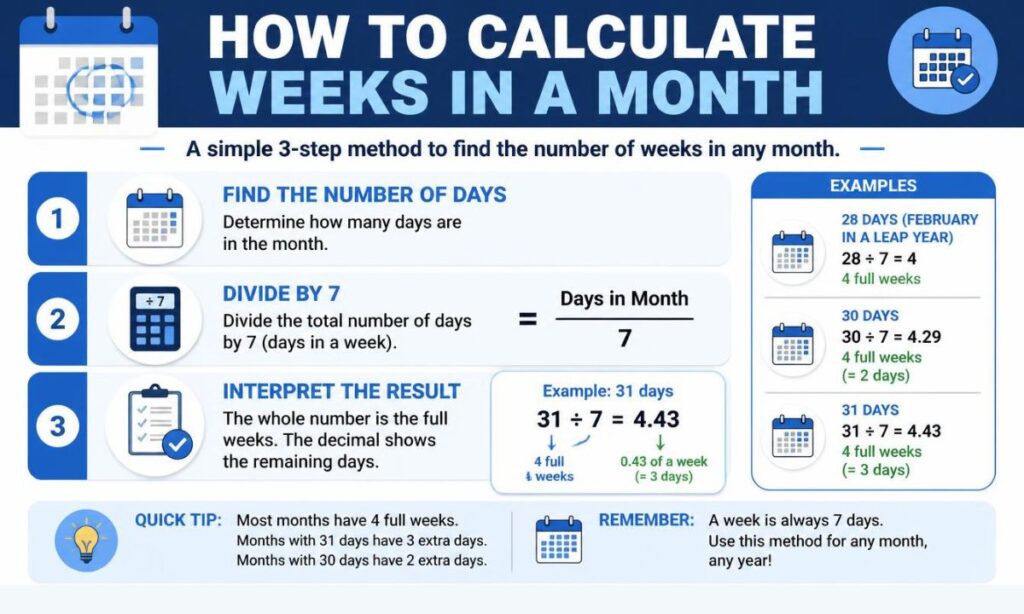
If you simply want to calculate weeks in a month, start with the number of days.
The basic formula is:
Number of days ÷ 7 = weeks
For a 31-day month:
31 ÷ 7 = 4 remainder 3
So there are 4 full weeks and 3 extra days.
For 30 days:
30 ÷ 7 = 4 remainder 2
So there are 4 full weeks and 2 extra days.
For 29 days:
29 ÷ 7 = 4 remainder 1
And for 28 days:
28 ÷ 7 = 4
This is a much better method than trying to count calendar boxes by eye, because calendar layouts can be deceptive. A visual fifth row isn’t necessarily a fifth week contained entirely inside that month.
How Five-Week Months Can Help With Planning
Once you understand the pattern, you can use it for more than winning a random calendar argument with your friend.
For weekly planning, knowing when a month has five occurrences of a weekday can help organize recurring activities. A person might schedule a special review on the fifth Monday, for example, rather than treating every Monday as identical.
The same idea can be useful for:
- Fitness schedules
- Habit tracking
- Weekly emails
- Content planning
- Email scheduling
- 12-week plans
- 16-week plans
- 30-day challenges
- Weekly habits
- Project timelines
If you’re building a content calendar, a fifth Monday or fifth Friday can become an extra publishing opportunity. If you’re following a fitness routine, it may serve as an additional review week. The calendar isn’t changing your plan, but knowing its shape lets you plan with fewer surprises.
Is There Ever a Month With Exactly Five Full Weeks?
No, not in the ordinary Gregorian calendar.
Five full weeks equal:
5 × 7 = 35 days
Since the longest standard calendar month contains only 31 days, no Gregorian calendar month contains five complete weeks.
What people call a “five-week month” is usually one of these:
- A month displayed across five calendar rows.
- A month containing five occurrences of one weekday.
- A month with a fifth partial calendar week.
- A five-week business or accounting period.
- A period that simply feels like five working weeks due to scheduling.
So the technically precise answer is that no standard month has five full weeks, but several months can have five occurrences of a weekday.
Which Months Have the Most Calendar Days?
The longest months are the 31-day months:
- January
- March
- May
- July
- August
- October
- December
These months have the greatest amount of room for repeated weekday occurrences.
The 30-day months are:
- April
- June
- September
- November
And February has either 28 or 29 days.
This pattern remains the same from year to year, although the day of the week attached to each date changes. That’s why January 1, for example, can fall on a different weekday in different years.
For people checking a specific year such as 2026, the exact weekday pattern can be calculated from the dates rather than guessed from the month length alone.
Five Weeks, Weekday Occurrences, and the Bigger Calendar Picture
It’s easy to get stuck thinking that a month should contain a neat number of weeks. But the calendar was never built that way.
A year has 365 days in a regular year, which leaves one day after 52 complete weeks. A leap year has 366 days, leaving two days after 52 complete weeks.
Those extra days move weekdays around from year to year.
That is why the number of weeks in each month isn’t a fixed whole number, and why the same month can have different patterns of five weekday occurrences in different years.
The month length provides the basic structure, while the starting weekday determines where the dates land. Think of it as a puzzle where the pieces are always the same size but the first piece moves slightly each time.
Quick Reference: Weeks in Every Month
For a fast reference, here is the practical breakdown:
| Month | Days | Full Weeks | Extra Days |
|---|---|---|---|
| January | 31 | 4 | 3 |
| February | 28/29 | 4 | 0/1 |
| March | 31 | 4 | 3 |
| April | 30 | 4 | 2 |
| May | 31 | 4 | 3 |
| June | 30 | 4 | 2 |
| July | 31 | 4 | 3 |
| August | 31 | 4 | 3 |
| September | 30 | 4 | 2 |
| October | 31 | 4 | 3 |
| November | 30 | 4 | 2 |
| December | 31 | 4 | 3 |
This table gives the full weeks and extra days mathematically. The number of visible calendar rows or weekday occurrences can still vary according to which day of the week the month begins.
Read more : How Many Weeks in November?
Frequently Asked Questions
Which Months Can Have Five Weeks?
Months with 29, 30, or 31 days can sometimes cover five calendar weeks, depending on which day of the week the month begins.
Does Every Month Have Five Weeks?
No. A month does not always contain five full weeks, but its dates can span parts of five different calendar weeks.
Which Months Have 5 Full Weeks?
A standard month cannot have five complete 7-day weeks because even a 31-day month has only four full weeks plus three extra days.
Why Do Some Months Look Like They Have Five Weeks?
Calendar layouts can show a month across five rows or weeks because the first and last days may fall on different days of the week.
Conclusion
So, what months have five weeks? If you mean five complete weeks, none of the standard Gregorian calendar months do, because five weeks require 35 days.
If you mean months that can have five occurrences of a particular weekday, then many months qualify. 31-day months are especially likely because they contain four full weeks plus three extra days. 30-day months can also have five occurrences of two weekdays, while leap-year February can have five occurrences of one weekday.
The easiest rule to remember is this:
28 days = 4 weeks
29 days = 4 weeks + 1 day
30 days = 4 weeks + 2 days
31 days = 4 weeks + 3 days
And there it is the slightly sneaky truth behind five-week months. A calendar month isn’t really a tidy block of weeks; it’s a collection of dates trying their best to fit into one.
Once you understand the relationship between the month, the weekday, and the number of days, those mysterious fifth Fridays and fifth Sundays become completely predictable. Whether you’re planning a paycheck, arranging weekly events, building a content calendar, or simply wondering why your calendar suddenly looks unusually crowded, the same little seven-day pattern explains it all.